Concrete leveling — usually called mudjacking or slab jacking — lifts sunken concrete back into place instead of tearing it out. Most residential jobs around Shreveport run a few hundred to a couple thousand dollars, roughly a third to half the cost of replacement.
Mudjacking lifts settled slabs by pumping grout underneath — most jobs finish in hours, cost far less than replacement, and last for years.
Concrete almost never sinks on its own — the soil under it does. In northwest Louisiana, that’s mostly clay: it swells when wet, shrinks when dry, and leaves voids under your slab. Heavy rain washing soil out from under a driveway edge does the same thing.
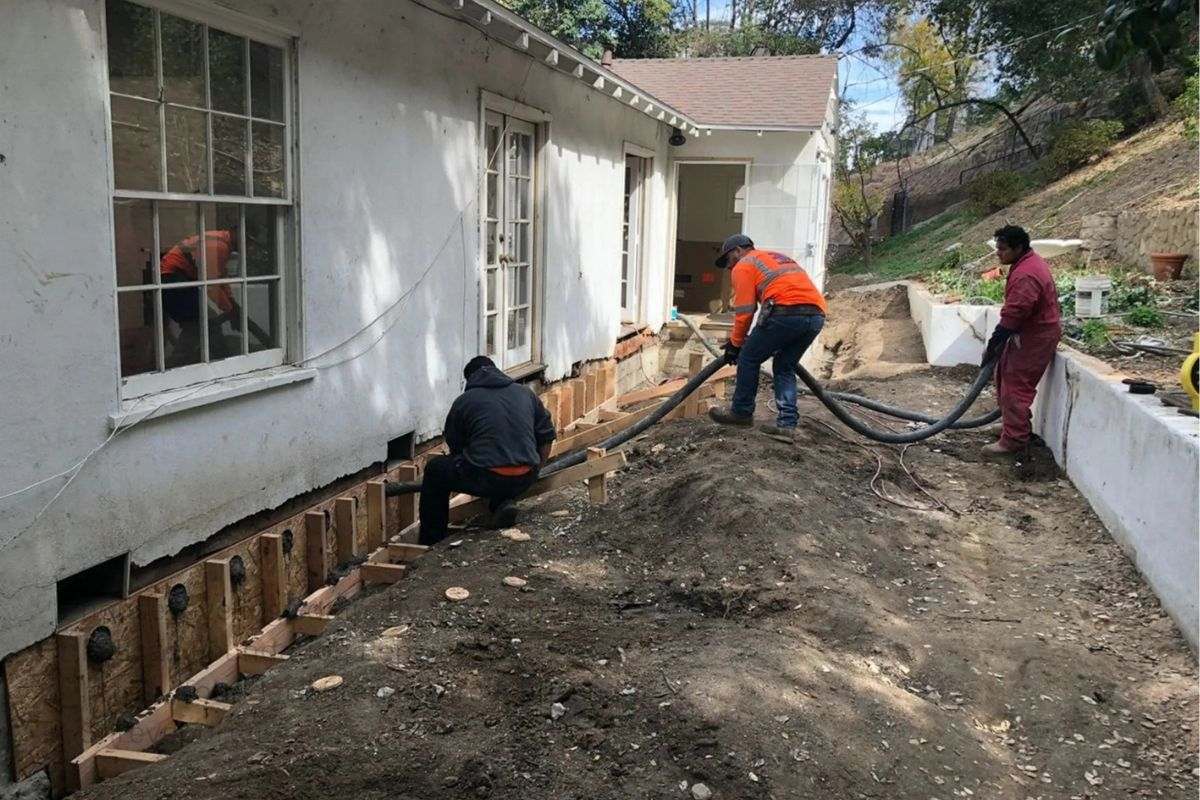
Leveling fixes the support problem, not just the concrete. Instead of ripping out a driveway, sidewalk, patio, garage floor, or pool deck, a crew pumps a lifting material through small drilled holes into the voids underneath. As the voids fill, the pressure raises your original slab back into position.
Why Do Slabs Sink in North Louisiana?
Around Shreveport, three things cause almost every sunken slab we see:
1. Clay shrinkage. The North Louisiana clay under our homes is expansive — it swells in the spring rains and shrinks during summer droughts. When it shrinks, the ground pulls away from the slab’s underside, leaving an air gap — and the next rain, the slab settles into it. Older Shreveport driveways and sidewalks repeat this cycle every year.
2. Poor compaction. Soil under driveways and patios should be compacted in layers during construction. If the builder rushed it, the soil keeps settling for years — which is why newer homes around Benton, Haughton, and Stonewall develop sunken slabs within a decade.
3. Water erosion. Downspouts dumping water next to a walkway, a yard draining across the driveway, or a gutter overflowing in a spring downpour all wash soil out from under the concrete edge. Homes in low spots around Cross Lake or along the Red River bottoms see this more, since the water table sits higher and the ground stays saturated longer.
Tree root damage usually lifts concrete rather than sinking it. A sunken slab is a soil problem nine times out of ten.
Mudjacking pumps grout under the slab to fill voids and lift it back up.
The process is simpler than most homeowners expect:
1. We find the low spots. A level or laser shows where the slab settled and where the voids are — plus the drainage problems that caused it, since lifting without fixing the water sets you up for a repeat.
2. We drill small holes. Holes roughly the size of a quarter are drilled at strategic points, a few feet apart, starting at the lowest area. Far less invasive than demolition.
3. We pump grout underneath. A cement-based grout — sand, limestone, and Portland cement mixed into a pumpable slurry (that’s the “mud” in mudjacking) — goes through the holes at low pressure. It fills the voids first, then pressure builds and the slab rises. We lift slowly, hole to hole, so the slab comes up evenly instead of cracking.
4. We seal the holes and clean up. The holes are patched with concrete and the site is cleaned. Most jobs finish in a few hours — walk on the slab the same day, drive on it the next.
Mudjacking vs. Polyurethane Foam Injection: Which Is Better?
You may have heard of foam jacking (also called polyjacking). Here’s the honest comparison:
Mudjacking uses cement-based grout — dense, strong, time-tested, and typically the most affordable option, with holes about one to two inches across. It fills large voids completely and handles heavy loads, which is why we recommend it for most residential slabs on Louisiana clay. For a step-by-step look, see this slab jacking guide from the Concrete Network.
Foam jacking (polyurethane injection) uses a two-part foam that expands as it’s injected. The holes are smaller (around five-eighths of an inch), the foam is far lighter than grout, it cures in about fifteen minutes, and it’s waterproof, so it resists future washout. That speed and water resistance cost more, and foam can be harder to control on large voids. Contractor guides commonly estimate mudjacking at roughly 5–7 years in challenging soils like Louisiana clay, versus 10-plus years for foam — the tradeoff is upfront cost versus longevity.
One important note: Pelican performs mudjacking — we don’t sell foam injection, so this is an honest apples-to-apples look, not a pitch for either. Foam can make sense on very soft or saturated soils where grout’s weight is a concern, or where fast cure time matters. For most Shreveport driveways, sidewalks, and patios on clay, mudjacking wins on cost, void-filling ability, and track record. We’ll tell you which fits your slab during the free inspection.
Which Concrete Surfaces Can Be Leveled?
Almost any flat slab that’s still structurally sound can be leveled — around Shreveport, most often:
Driveways. The apron drops where it meets the garage floor, panels tilt into a washboard ride, or the edge crumbles where water runs off the yard. Leveling the apron alone can fix a car bottoming out for a fraction of replacement.
Sidewalks and walkways. A panel even half an inch above its neighbor is a trip hazard. Leveling brings it flush in an hour or two, with no excavation along your landscaping.
Patios. A patio sloping toward the house sends rainwater at your foundation walls. Leveling restores the pitch and pairs well with drainage work.
Pool decks. Pool construction disturbs the surrounding soil, which settles for years — making pool decks some of the worst offenders. (If the pool shell itself is shifting, that’s a different problem, and we’ll tell you so.)
Garage floors, steps, and porches. A dropped garage corner means puddles and uneven storage. A front stoop pulling away from the house leaves a gap where water pours against the foundation. Both are quick lifts.
The rule: the slab needs to be at least four inches thick and in a few large pieces. Thin, shattered, or crumbling concrete can’t be lifted.
When Leveling Works — and When Replacement Is Smarter
Leveling is a great solution, but not for every slab. Here’s our honest read:
Leveling is a good fit when: – The slab is mostly intact but settled or tilted – There are trip hazards on a sidewalk or steps – A driveway or patio slopes toward the house (often a drainage issue — see our drainage correction services) – Pool deck or garage floor sections have dropped a few inches – The concrete is at least four inches thick and in large, sound pieces
Replacement is smarter when: – The slab is shattered — spiderwebbed cracks, crumbling pieces, or broken sections – The concrete is badly spalled (flaking apart) from age or surface damage – The base underneath has completely washed away – The slab is thinner than four inches — thin pours crack during lifting – A previous leveling job failed and it’s sinking again (a sign of a deeper soil problem)
We won’t sell you a leveling job if your concrete is past saving. During your free inspection, we’ll tell you straight which option makes sense — and if that’s replacement, we’ll say so.
How Much Does Concrete Leveling Cost in Shreveport?
Most residential concrete leveling projects in the Shreveport area cost in the high hundreds to low thousands — a small sidewalk section at the lower end, a full driveway or pool deck at the higher. A national directory puts the Shreveport average around $4.80 per square foot — but that’s a directory average, not our quote. Compare it to the $3,500–$15,000+ range of a full pier-based foundation job, and you can see why leveling is the budget-friendly fix for surface concrete.
What moves your price up or down:
Slab size and panel count. More square footage means more grout and more holes — a single walkway panel costs far less than a two-car driveway.
How far it settled. A half-inch drop needs a thin fill; a three-inch drop means a big void, more material, and more time.
Access for equipment. The pump and hoses must reach the slab — a front driveway is easy; a backyard patio behind a narrow gate takes more setup.
Underlying drainage work. If a downspout or grading problem caused the sinking, fixing it alongside the leveling adds a little to the bill — and saves you from paying for the job twice.
The inspection itself is always free: we assess the slab, explain your options, and give you a written quote at no cost.
Done right, with the cause addressed, a leveled slab lasts for years — often the remaining life of the concrete. The grout becomes part of the slab’s base: nothing to rot, rust, or compress.
The main reason a slab settles again is the same reason it settled the first time — water moving through the soil underneath. That’s why we check drainage on every inspection. For context, contractor guides commonly estimate mudjacking at roughly 5–7 years in challenging soils like Louisiana clay, versus 10-plus years for foam — which is why the drainage check matters more than the material.
Our structural foundation repairs carry a 20-year warranty on qualifying work, and we’ll put every promise about your leveling job in writing before we start.
Is Leveling Worth It for Your Slab?
For most homeowners with settled surface concrete, yes: it’s far cheaper than replacement, most jobs finish in half a day, and it fixes trip hazards, water pooling against your foundation, and washboard driveways — while protecting the foundation itself when paired with drainage correction. (See our slab foundation repair page if you’re seeing related warning signs.)
The one time it’s not worth it is when the slab is destroyed beyond lifting. That’s a judgment call we’ll make honestly, on site, for free.
Mudjacking — also called slab jacking or concrete leveling — raises sunken concrete by pumping a cement-based grout through small drilled holes into the voids beneath the slab. It works on driveways, sidewalks, patios, garage floors, pool decks, and steps.
What does concrete leveling cost per square foot?
A national directory puts the Shreveport average around $4.80 per square foot for mudjacking-style leveling — but that’s a directory average, not our quote. Small sidewalk sections run a few hundred dollars; full driveways run into the low thousands. The free inspection gives you an exact number for your slab.
What’s the difference between mudjacking and polyurethane foam?
Mudjacking pumps a cement-based grout — dense, affordable, and excellent at filling large voids, with holes about the size of a quarter. Polyurethane foam is lighter, waterproof, cures in about 15 minutes, and uses smaller holes — but costs more. Contractor guides commonly estimate mudjacking at roughly 5–7 years in tough soils like Louisiana clay, versus 10-plus years for foam. We perform mudjacking; foam is offered by other contractors.
How long does the mudjacking process take?
A walkway section takes an hour or two; a full driveway, most of a day. Foot traffic the same day.
When can I drive on the leveled concrete?
Foot traffic is fine the same day. For driveways and garage floors, wait until the next day before parking vehicles — the grout keeps gaining strength for several days, and one night of patience protects the lift.
Will leveling work on stamped or decorative concrete?
Yes, and it’s often the best option — replacing stamped concrete is expensive, and matching the pattern is nearly impossible. The patched holes may be slightly visible, so we’ll show you where they’ll go before we start.
Does the pumped grout’s weight cause more sinking?
No. The grout spreads across the slab’s entire footprint, so the load is distributed — it doesn’t punch through like a point load. Where soils are extremely soft and weight is a real concern, foam injection — offered by other contractors — is the lighter alternative.
Can you mudjack a slab more than once?
Yes, but a repeat lift is a warning sign, not routine maintenance. If a slab sinks again after leveling, the soil underneath is still moving — usually a drainage or compaction problem that wasn’t fixed the first time. We’d rather fix the cause than sell you the same lift twice.
Do I need to fix my drainage before leveling?
Yes — eventually. Leveling without fixing the water problem is temporary; the soil will erode again. We can usually bundle a simple fix, like downspout extensions or minor regrading, into the same visit.
How do I know if my slab can be leveled or needs replacing?
Quick rule of thumb: if the slab is in a few large pieces and the main problem is settling or tilting, it can probably be leveled. If it’s crumbled, spiderwebbed, or falling apart, replacement is the call. The free inspection settles it definitively.
Get a Free Inspection in Shreveport
If part of your concrete has sunk, tilted, or turned into a trip hazard, don’t wait — settled slabs only keep settling. Pelican Foundation Repair offers free, no-pressure inspections across Shreveport — all ZIPs including 71104, 71105, 71108, 71118, and 71129 — and surrounding areas, including Bossier City, Blanchard, Greenwood, Keithville, Benton, Stonewall, Haughton, Red Chute, Eastwood, Mooringsport, Minden, and Ruston. We’ll tell you whether leveling or replacement makes sense and give you a clear written quote.
Call us at (318) 585-2003 to schedule your free inspection. We’re open Monday–Friday 7:00–6:00 and Saturday 8:00–2:00.
 Skip to main content