Concrete Driveway Repair Cost in Shreveport, LA: Repair, Leveling, or Replace?
Shreveport clay soil, summer heat, and heavy rain decide what your driveway costs to fix. Compare crack sealing, leveling, resurfacing, and replacement here.
Concrete driveway repair cost in Shreveport, LA depends on the fix your driveway actually needs, not on a single flat price. A few sealed cracks cost far less than lifting a sunken slab, and resurfacing costs far less than tearing the whole driveway out.
Two driveways on the same street can look alike from the curb and need very different work. One has hairline cracks from a hot, dry summer, while the other has sunk two inches where the clay soil under it washed out. The price follows the problem, not the other way around.
This post lists no Pelican prices. Your exact price comes from a written estimate after an expert inspection.
What Does Concrete Driveway Repair Cost in Shreveport, LA?
Start with the national picture, then bring it home. Angi reports a 2026 national average for concrete driveway repair, based on verified projects from its pros. That is an industry range, not a Pelican price. most standard repair projects in its city guides span a wide band.
Why such a wide spread? Because “driveway repair” is not one job. Sealing a hairline crack takes an hour and a tube of filler. Lifting a sunken slab takes a crew, a pump, and material injected under the concrete. Resurfacing bonds a new thin layer over the old slab, and replacement breaks out the old concrete and pours fresh concrete that must cure first.
Shreveport adds its own twist. Our expansive clay soil swells when it gets wet and shrinks when it dries out, and it does both in the same year. A long hot summer in the 71106, 71105, or 71118 ZIP codes can dry the clay under a driveway until it pulls away from the slab. Then a heavy Gulf rain soaks the same soil, and it swells back up. That shrink-swell cycle cracks concrete and lets slabs settle at different heights. A driveway in South Highlands faces the same soil as one in Broadmoor, but shade, trees, and drainage change how fast the damage shows up.
Repair vs Leveling vs Resurfacing vs Replacement: The Cost Table
This is the comparison most homeowners in Shreveport actually need. Four options, four price bands, four different jobs. Find the row that sounds like your driveway, then check the last column before you decide.
| Option | Industry range | Best for | Watch out for |
|---|---|---|---|
| Crack sealing and patching | Priced per linear foot for minor cracks; pothole fixes priced per job | Hairline cracks, small chips, one or two bad spots on a mostly sound slab | Sealant cannot fix a slab that is still sinking; cracks wider than a quarter inch often point to movement below |
| Concrete leveling (mudjacking or foam) | Priced per square foot, industry range | Sunken slabs, tripping lips at joints, a driveway that settled unevenly but is not crumbling | Leveling cannot save concrete that is badly cracked through or crumbling; the soil cause must be addressed too |
| Resurfacing (bonded overlay) | Priced per square foot for a basic finish, higher with heavier prep, industry range | Worn, stained, or lightly scaled surface on a stable, level slab | An overlay bonds to the old slab, so it mirrors cracks and movement underneath if the base is failing |
| Full replacement (tear out and repour) | Priced per square foot for standard concrete, industry range | Widespread damage, more than 25% of the surface failing, crumbling concrete, or a washed-out base | Highest cost and longest disruption; new concrete needs curing time before you can drive on it |
Read the table as a ladder. Each step up costs more and fixes a deeper problem: sealing treats the surface, leveling treats the height of the slab, resurfacing treats the look of the surface, and replacement treats the whole slab and its base.
What Drives Your Driveway Repair Price Up or Down in Shreveport?
How Much of the Driveway Is Damaged
Size of the damaged area matters more than size of the driveway. A single cracked panel costs far less to fix than cracks running across five panels. Contractors use a rough rule that Angi also cites: if more than 25% of the surface is visibly damaged, resurfacing or replacement usually beats repeated patching. Count the bad panels before you call.
The Soil and Base Under the Slab
This is the Shreveport driver, and it is the one most often missed. Our clay soil moves with moisture, and a driveway slab is only as good as the base under it. If water has washed soil out from under a slab, the slab will keep sinking no matter how many times you seal the crack on top. If a downspout dumps roof water at the edge of the drive, the soil stays wet on one side and the slab tilts.
Crack Width, Depth, and Pattern
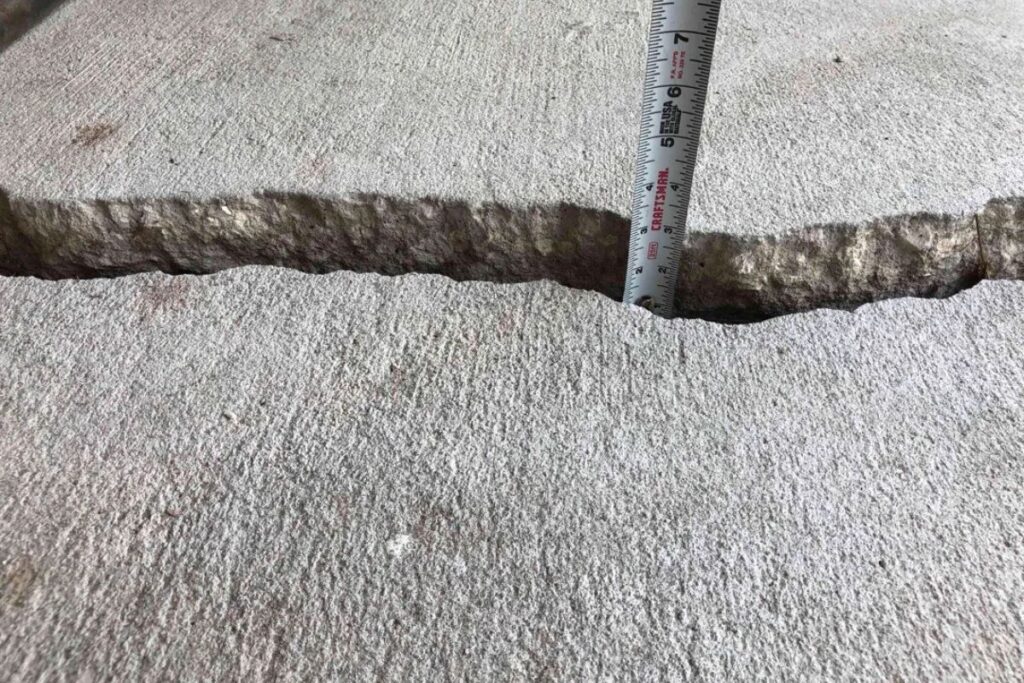
Not all cracks cost the same. A hairline surface crack is a sealing job. A crack wider than a quarter inch, a crack that runs across the full slab, or a crack with one side higher than the other points to movement below, and the fix gets bigger. Measure the widest cracks and note whether one side has dropped.
- Count the damaged panels and measure the widest cracks before you call anyone.
- Look for the water path: downspouts, slope, and low spots that hold water against the driveway.
- Note which side of the slab has dropped and by how much, using a straight board and a tape.
- Check the joints: wide, crumbling, or missing joint filler lets water under the slab.
Crack Sealing and Patching: The Small Fixes That Work
Crack sealing is the smallest, cheapest fix in the table, and it is the right fix when the slab itself is still sound. A hairline crack — thinner than a credit card edge — is usually shrinkage from curing or from a hot, dry summer. Clean it out, fill it, and seal it so water cannot get in.
Water is the enemy here. Once it gets under the slab through an open crack, it softens the base, and the next dry spell lets the clay shrink away from the concrete. Patching covers the next step up: a small spalled spot where the surface has flaked off, a chipped corner, or a shallow pothole in the slab. A patch fills the hole and bonds to the old concrete, and it works well when the damage is local and the slab around it is solid.
If a crack keeps reopening, if one side keeps dropping, or if new cracks appear every few months, the slab is still moving and sealant will not stop it. A homeowner in the 71118 ZIP code faces the same test as one near the Red River in 71105: if the crack moves, the cause is below.
When Sealing Is Enough, and When It Is Not
Sealing is enough when the slab is level, the cracks are narrow and stable, and the damage covers only a small part of the drive. It is not enough when the slab has sunk, when cracks are wide or growing, or when water pools on the driveway after rain. Our guide to concrete leveling cost in Shreveport explains the next step up in detail.
Leveling, Resurfacing, and Replacement: How to Choose
This is the decision tree. Work through it in order, and it will point you to one of the three bigger fixes. Start with the slab, not the surface: a driveway that looks rough but sits level is a different job from a driveway that looks fine but has sunk two inches at the street. Our comparison of leveling concrete or replacing it covers lifespan and cost in more detail.
Choose Leveling When the Slab Has Sunk but Is Not Crumbling
Leveling lifts a sunken slab back toward its original height by injecting material underneath it — a cement-based slurry in mudjacking, or expanding polyurethane foam in foam leveling. It fits a slab that is still in good shape but has settled, leaving a lip at a joint or a low spot that holds water. Industry ranges price leveling per square foot, and the band is wide because foam and slurry, depth of lift, and access all change the number. That is an industry range, not a Pelican price.
A raised lip of even half an inch at a joint is a tripping hazard, catching tires, lawn equipment, and feet. Our post on concrete tripping hazards and liability explains why a small lip is worth fixing promptly. If your driveway has a lip and the slab is sound, leveling is usually the best value.
Choose Resurfacing When the Slab Is Stable but Looks Worn Out
Angi prices basic driveway resurfacing per square foot, rising with heavy prep, and gives a 2026 national average for a resurfacing project. Those are industry ranges, not Pelican prices. The hard limit is the base. An overlay is only as good as the slab it bonds to, so a moving slab will crack the overlay in the same places.
Choose Replacement When the Damage Is Widespread or the Base Has Failed
Replacement is the biggest, most disruptive, and most complete fix. The old concrete comes out, the base is inspected and rebuilt, and a new slab is poured. It is the right call when more than 25% of the surface is failing, when the concrete is crumbling through its full depth, or when the base has washed out and the driveway will keep sinking. Industry ranges price a new standard concrete driveway per square foot. That is an industry range, not a Pelican price.
- Slab level and damage under 25%: seal the cracks or resurface the worn surface.
- Slab sunk but concrete sound: level it, then fix the drainage that let it sink.
- Damage over 25%, crumbling concrete, or a failed base: replace the driveway.
- Cracks that keep growing or a slab that keeps dropping: get an expert inspection before spending on any surface fix.
How to Get a Written Estimate You Can Trust
A good estimate is a written document, not a number spoken at the curb. It should name the fix, the area it covers, the materials, the prep work, the haul-away, the sealing, and the curing time, each on its own line. It should say what the warranty covers. Pelican offers a 20-year structural warranty on qualifying repairs, and the wording matters: qualifying repairs, not every job.
Compare at least two written estimates, line by line. A lower total that leaves out prep, haul-away, or sealing is not lower at all. A higher total that includes drainage work may be the cheaper job in the long run, because it fixes the cause instead of the symptom. Ask each contractor the same four questions: what is causing the damage, what fix matches that cause, what is included, and what happens if the base is worse than expected.
Start with the Pelican Foundation Repair homepage and the concrete driveway repair service page, and the concrete leveling service page to see how Pelican approaches each fix, then book an expert inspection for your own driveway. The Angi guide to concrete driveway repair cost and Angi’s concrete resurfacing cost guide set out the same national ranges used in this post. Both are industry ranges, not Pelican prices.
Frequently Asked Questions
How much does concrete driveway repair cost in Shreveport, LA?
It depends on the fix. Angi reports a 2026 national average for concrete driveway repair, an industry range, not a Pelican price. Small crack work sits near the low end. Your exact price comes from a written estimate after an expert inspection.
Is it cheaper to repair or replace a concrete driveway?
Repair is cheaper when the damage is local and the slab is sound. Replacement is cheaper in the long run when more than 25% of the surface is failing or the base has washed out. Repeated patching costs more over time than one replacement done right.
How much does concrete driveway resurfacing cost per square foot?
Angi prices basic concrete driveway resurfacing per square foot, rising with heavy prep. That is an industry range, not a Pelican price. Your exact price depends on prep and condition.
Can a sunken concrete driveway be leveled instead of replaced?
Yes, if the concrete is still sound. Leveling lifts a sunken slab by injecting material underneath it, and it works well for settled slabs with a good surface. If the base has failed, leveling will not hold and replacement is the better call.
How long does a concrete driveway repair last?
It depends on the fix and the cause. Sealed cracks last as long as the slab stays stable. Leveling and resurfacing last for years when the soil and drainage are addressed, but any surface fix fails early if the slab keeps moving.
Does homeowners insurance cover concrete driveway repair in Louisiana?
Usually not for wear, age, or soil movement, which insurers often treat as maintenance. A sudden covered event, such as damage from a fallen tree, may be different. Check your own policy wording before assuming a repair is covered.
When should I call a specialist about my driveway?
Call when a crack is wider than a quarter inch, when one side of a slab has dropped, when cracks keep growing, or when a raised lip creates a tripping hazard. Get an expert inspection to find out which fix matches it.
Pelican Foundation Repair
6118 Fairfield Ave, Shreveport, LA 71106, USA
318-585-2003
https://foundationrepairshreveport.com/