 Skip to main content

Can a Slab Foundation Be Repaired? Yes — Here’s How
Yes — a slab foundation can absolutely be repaired. In most cases, a cracked or settled slab does not need to be torn out and replaced. Modern methods like steel push piers, helical piers, polyurethane foam leveling, and epoxy crack injection can restore a slab’s strength and level — often in just a few days.
That surprises many Shreveport homeowners, but slab settlement is one of the most common — and most fixable — foundation problems in northwest Louisiana. The key is matching the right repair to the right problem, which this guide walks you through.
Call (318) 585-2003 – Free Inspection
📊 Slab Repair at a Glance
Yes
Cracked and settled slabs can be structurally repaired
$3,500–$15,000+
Typical range for slab repair in Shreveport
20-year
Structural warranty on qualifying repairs
Why Slab Foundations Settle in Shreveport
Most Shreveport homes built since the 1970s sit on a concrete slab — a thick, reinforced pad poured directly on the ground. Southern Hills, Ellerbe, and the Red Chute area are overwhelmingly slab-on-grade, while older areas like Highland, South Highlands, Broadmoor, and Cedar Grove are mostly pier-and-beam — and the two types fail and get fixed in different ways.
The number-one enemy of slabs in Caddo Parish and Bossier Parish is the soil itself. Northwest Louisiana is covered in expansive clay soil — clay that swells when it soaks up water and shrinks when it dries out. Our long, wet springs followed by hot, dry summers put that cycle on repeat every single year. When the clay under one corner of your slab shrinks more than the clay under the rest, that corner loses support and sinks. Engineers call it differential settlement, and it is the reason slab cracks and sloping floors are so common from South Shreveport to Benton.
A few local factors make it worse. Poor drainage — gutters dumping water next to the foundation, yards sloping toward the house — keeps one side of the slab wetter than the other. Big trees pull surprising amounts of moisture out of the clay during droughts, which is why you will often see the worst settlement on the side of the house near a large oak. And in newer subdivisions, the soil under the slab was disturbed and re-compacted during construction, which can leave soft spots that settle years later. The LSU AgCenter publishes research on how Louisiana’s expansive clay soils affect foundations at lsuagcenter.com.
Here is the good news: because settlement from clay soil is so predictable, slab repair methods are well proven here. Contractors in Shreveport deal with this exact soil every day, and the fixes — piers, foam, crack repair — were designed for exactly this kind of movement.
When a Slab Can Simply Be Patched
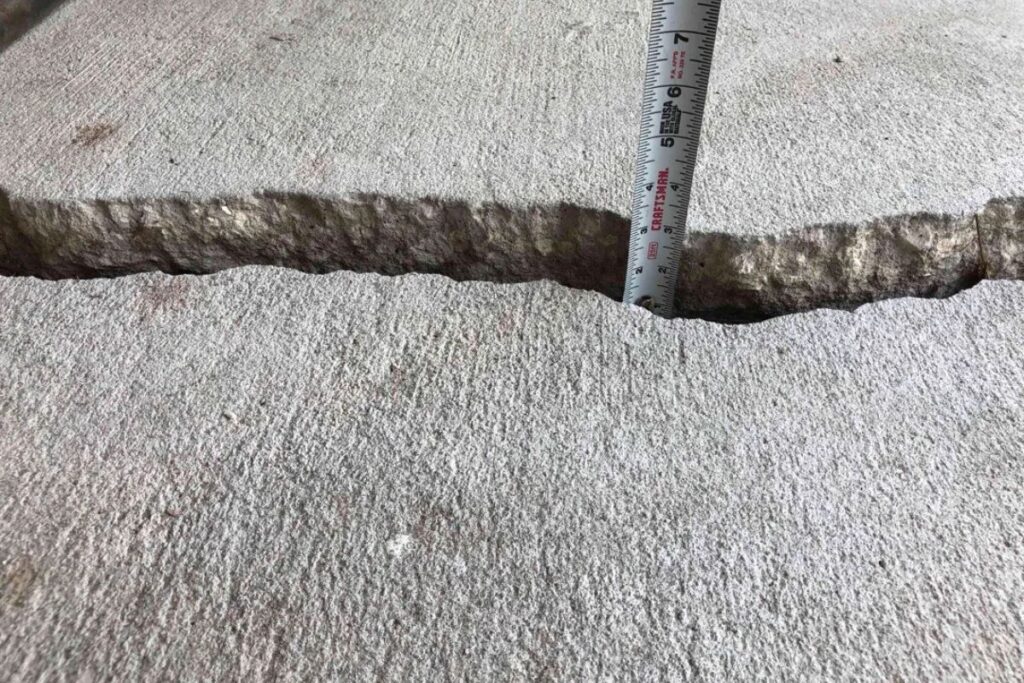
Not every slab crack is structural. Concrete shrinks as it cures, and new slabs often develop thin hairline cracks — called shrinkage cracks — within the first year or two. They are usually less than 1/16 inch wide, run in random directions, and sit level on both sides. If that describes your crack, it can almost always be patched.
The standard fix is crack injection. A technician cleans out the crack and injects it with either epoxy or expanding polyurethane. Epoxy bonds the two sides back together and actually restores the concrete’s strength across the crack; polyurethane stays flexible and seals out water. Either way, the job takes a few hours and costs a few hundred dollars — far less than any structural repair. We walk through the process step by step in our guide on how to fix a cracked slab foundation in Shreveport.
Patching also works for minor surface damage: small chips along the slab edge and hairline garage-floor cracks that have not moved in years. The key test is movement — mark both ends of the crack and check it every few months. If it is not getting wider, longer, or uneven, patching is a reasonable fix.
Patching cannot lift a settled slab or stop soil movement. If the crack keeps growing or one side sits higher than the other, injection is just a bandage — the settlement underneath will keep going and eventually crack the patch too.
Call (318) 585-2003 – Free Inspection
When Patching Is Not Enough: Signs Your Slab Needs Underpinning
Underpinning is the structural answer to slab settlement: piers that transfer your home’s weight from unstable surface clay down to deeper, load-bearing soil. It is a permanent fix for loss of support, not a cosmetic one. Here are the signs your slab has moved past the patching stage.
- Cracks that keep growing. A hairline crack that gets wider every year, or one you can fit a coin into, is telling you the slab is still moving.
- Uneven crack edges. Run your hand across the crack. If one side sits higher than the other, that section of slab has dropped — no injection can level it.
- Sticking doors and windows. When a slab settles unevenly, door and window frames twist. If several doors around the house suddenly rub or will not latch, the foundation — not the doors — is the problem.
- Sloping or bouncy floors. Set a marble or a golf ball on the floor and watch where it rolls. A gentle slope toward one corner usually matches the settlement pattern a contractor will map during inspection.
- Gaps where the slab meets walls. Look for separation between the floor and baseboards, or between exterior brick and window frames. Gaps mean parts of the structure are moving apart.
- Plumbing problems. Slab homes run drain lines under the concrete. Settlement can stress or break those lines, so recurring clogs, sewer smells, or unexplained wet spots can be a foundation symptom, not just a plumbing one.
If you are seeing two or more of these, skip the patch and get an inspection. Exterior piers go in from outside the home; interior piers handle settlement in the middle of the slab. Either way, the goal is the same: bypass the moving clay. Our slab foundation repair page explains how the pier plan is matched to each home.
Steel Push Piers vs Helical Piers for Slab Foundations
In Shreveport, the choice usually comes down to steel push piers or helical piers — sometimes a combination of both on the same house.
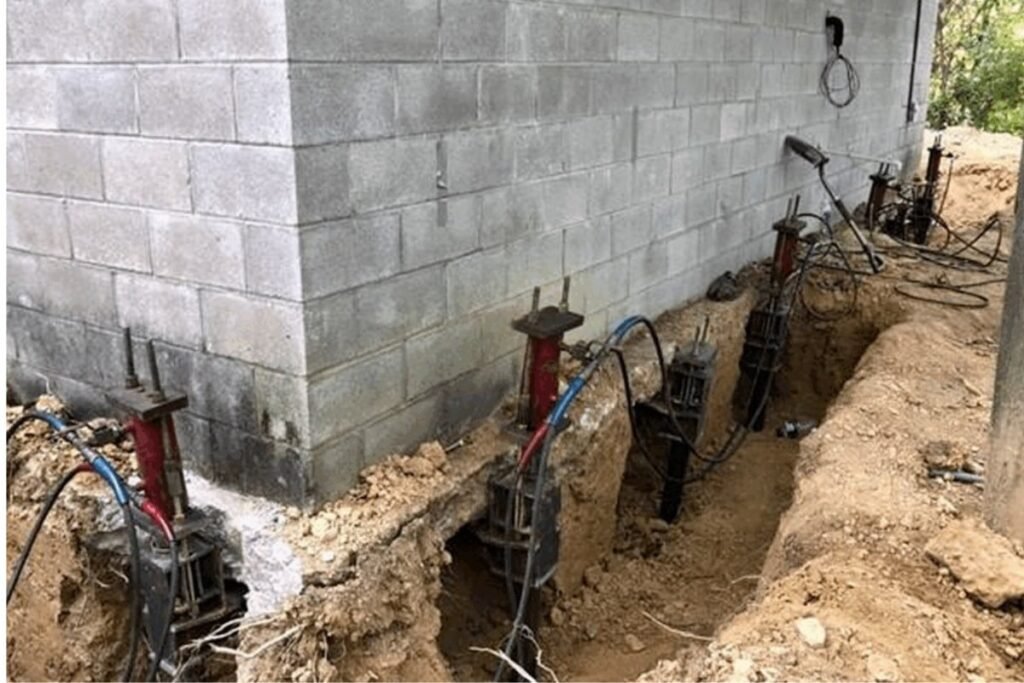
Steel push piers are heavy steel pipe sections hydraulically driven into the ground until they reach load-bearing soil. The crew monitors pressure on every pier to confirm bearing depth — important in parts of Caddo Parish where stable soil sits 20 feet or more down. Hydraulic jacks then lift the slab in small, controlled increments.
Helical piers work more like giant screws. Each pier has steel plates (helices) welded along its shaft, and a machine rotates it into the ground. The installer tracks the torque — the twisting resistance — to confirm the pier has reached bearing depth. Helicals work well in softer or wetter soils and in tight spaces where driven piers will not fit.
A third option is interior piers. When the middle of a slab settles — common under long hallways — exterior piers cannot reach it. The crew opens small sections of the interior floor, installs piers under the slab, and patches the concrete afterward.
| Pier type | How it is installed | Best for |
|---|---|---|
| Steel push piers | Hydraulically driven to bearing soil | Deep stable soil; heavy settlement; most Shreveport slab homes |
| Helical piers | Screwed in; torque-verified | Softer or wet soils; tight spaces; lighter structures and additions |
| Interior slab piers | Installed through the floor slab | Settlement in the middle of the slab that exterior piers cannot reach |
There is no universal winner. A trustworthy contractor will explain why they recommend one system for your specific lot, not just quote the one they sell.
Call (318) 585-2003 – Free Inspection
Polyurethane Foam Leveling for Sunken Slabs
Not every settled slab needs piers. For shallow settlement — a sunken garage floor section, a porch slab down an inch or two, a rocking driveway panel — polyurethane foam leveling (foam jacking) can be the right tool.
The crew drills dime-sized holes through the slab and injects two-part polyurethane foam underneath. The foam expands, fills soil voids, and lifts the concrete back toward level, curing in about 15 minutes — so you can usually drive on a lifted driveway the same day.
Foam is ideal for filling voids where soil has washed out, leveling interior floors that have settled an inch or less, and raising exterior concrete like patios and walkways. It also works as a finishing step after piers, filling gaps between the lifted slab and the soil.
But foam has real limits. It does not reach deep, stable soil — it floats the slab on the same shallow clay layer that caused the problem. With significant settlement, sticking doors, or recurring cracks, foam alone will not stop the movement. In those cases, underpinning is the structural fix. To compare approaches, browse our foundation repair services.
Slab vs Pier-and-Beam: What Shreveport Homes Sit On
The repair conversation is completely different for each foundation type. Southern Hills, Ellerbe, and newer sections near Red Chute are slab-on-grade — concrete poured directly on the ground with plumbing buried underneath — the standard for new homes across northwest Louisiana since the 1970s.
Highland, South Highlands, Broadmoor, and Cedar Grove are different: many homes there date to the early and mid-1900s and sit on pier-and-beam foundations, leveled by adjusting piers and shimming beams — a very different job from underpinning a slab.
Why does this matter? The warning signs differ: slab homes show floor cracks, sloping tile, and plumbing issues, while pier-and-beam homes show sagging floors and musty crawl space smells. The repair methods and costs differ too. If a contractor quotes a pier-and-beam style repair for a slab home (or vice versa), that is a red flag.
Not sure which you have? Look at the base of your home: concrete running straight up to the siding means slab; a gap, vents, or an access door means pier-and-beam. A free inspection confirms it in minutes.
Call (318) 585-2003 – Free Inspection
What Slab Foundation Repair Costs in Shreveport, LA
Here are honest ranges for the Shreveport market. These are typical residential ranges, not quotes — your home’s size, settlement pattern, and soil conditions set the final number.
Crack injection for non-structural cracks usually runs $500–$1,500 depending on the number and length of cracks. Polyurethane foam leveling typically falls between $3,500–$8,000 for a residential job, with larger areas and deeper voids pushing toward the top of that range. Full pier underpinning — the structural fix for a settled slab — generally runs $3,500–$15,000+, driven mostly by how many piers your home needs. A small corner lift might take six piers; a full perimeter job on a larger home can take twenty or more.
Interior piers cost more than exterior ones because of the floor work. Deep bearing soil means longer piers and more driving time. And broken drain lines under the slab — common when settlement stresses old plumbing — get bundled into the project.
The most expensive option is doing the wrong repair first — paying for foam when you needed piers means paying twice. That is why an inspection with elevation readings matters more than any price range online. For a deeper breakdown, see our slab foundation repair cost guide for Shreveport.
Keeping Your Slab Stable After the Repair
A repaired slab is only as stable as the soil around it. Expansive clay moves when its moisture content swings — your job is to keep the swings small.
- Manage water at the roofline. Clean gutters and downspouts that discharge at least five feet from the foundation. A single clogged gutter can dump hundreds of gallons next to one corner of your slab during a spring storm.
- Grade soil away from the house. The ground should slope away from your foundation in every direction. Low spots that pond water against the slab are settlement waiting to happen.
- Keep moisture consistent in dry spells. During Shreveport’s hot, dry summers, the clay shrinks as it dries. A soaker hose run on a timer around the foundation — not flooding, just consistent light watering — helps prevent the shrinkage cycle.
- Watch large trees. Mature oaks and pines drink enormous amounts of water. If a big tree sits close to the house, consider root barriers or talk to an arborist before removal suddenly changes the moisture balance.
- Recheck after big weather. After an unusually wet spring or a drought summer, walk your home and look for new cracks or sticking doors. Catching movement early keeps small problems small.
Pelican backs qualifying structural repairs with a 20-year structural warranty. The InterNACHI foundation inspection standards at nachi.org are a good reference for what a thorough post-repair checkup should cover. Pair a solid repair with steady soil moisture, and your slab should stay put for decades.
Call (318) 585-2003 – Free Inspection
Frequently Asked Questions
Can a slab foundation be repaired without tearing it up?
Yes. Most slab repairs happen without removing the slab: exterior piers are installed from outside the home, foam goes in through dime-sized holes, and crack injection needs no demolition at all. Only interior piers require opening small sections of floor — and the crew patches the concrete afterward.
How much does it cost to repair a slab foundation in Shreveport?
Most Shreveport homeowners pay $3,500 to $15,000+ depending on the method: crack injection runs $500–$1,500, foam leveling $3,500–$8,000, and full pier underpinning $3,500–$15,000+. A free inspection with elevation readings is the only way to get an accurate number for your home.
Can a cracked slab be fixed, or does the whole slab need to be replaced?
Full slab replacement is extremely rare for residential homes. Stable cracks are sealed with epoxy or polyurethane injection, and settled sections are lifted with piers or foam. Replacement only comes up with severe deterioration — widespread crumbling, not just cracking — which is uncommon in Shreveport.
How do I know if my slab needs piers or just crack repair?
Look for movement. Stable cracks — not widening, not uneven, with doors and floors working fine — usually just need crack repair. Growing cracks, uneven edges, sticking doors, or sloping floors mean the slab has lost support and needs underpinning. An inspection with elevation readings shows exactly where — and how much — the slab has dropped.
How long does slab foundation repair take?
Most slab repairs take one to five days of on-site work: crack injection in a day, foam leveling in one to two days, and exterior pier installation in two to four days. Interior pier jobs take three to five days because of the floor work. You can stay in your home for nearly all of it.
Will slab repair damage my floors, yard, or landscaping?
Exterior pier work disturbs the soil around the foundation, but good crews keep excavations tight, backfill and compact properly, and clean up daily — grass recovers. Foam leveling barely touches the yard. Interior piers require cutting the floor — the most disruptive option — but the concrete is patched afterward. Ask what restoration is included before work starts.
Is a repaired slab as strong as it was originally?
When the right method is used, yes. With underpinning, supported sections are often more stable than the original construction, because piers bypass the problem soil and rest on deep, load-bearing strata. Epoxy injection restores the concrete’s strength across a crack. What matters is matching the repair to the cause: piers for settlement, injection for stable cracks, foam for shallow voids.
Call (318) 585-2003 – Free Inspection
Get a Free Slab Foundation Inspection in Shreveport
The only honest repair plan starts with elevation readings from your actual home. A free inspection maps exactly where your slab has settled, what caused it, and which fix — patching, foam, or piers — actually solves it.
Call Pelican Foundation Repair at (318) 585-2003, or visit Pelican Foundation Repair to schedule. We serve Shreveport and surrounding areas including Bossier City, LA. For method details, see our slab foundation repair services.
Pelican Foundation Repair 6118 Fairfield Ave, Shreveport, LA 71106, USA 318-585-2003 https://foundationrepairshreveport.com/