 Skip to main content
Concrete Slab Foundation Repair Cost in Shreveport, LA
Concrete slab foundation repair cost in Shreveport LA typically runs $400–$1,500 for crack repair and $3,500–$15,000+ for pier stabilization. Where your job lands depends on how far the slab has moved and how crews can reach it. Pelican Foundation Repair inspects foundations for free, so you can get an exact number for your home.
Crack repair, slab piers, or a combination — the right fix depends on whether your slab is cracked or sinking; a free inspection tells you which.
Call (318) 585-2003 – Free Inspection
📊 Slab Foundation Repair Cost at a Glance
$400–$800
Hairline crack repair
$800–$1,500
Structural crack repair
$3,500–$15,000+
Full slab pier stabilization
What Does Slab Foundation Repair Actually Involve?
Most homes in Shreveport sit on a concrete slab — either a single thick pour with reinforced edges or a slab with grade beams running underneath. When people say “slab foundation repair,” they usually mean one of three jobs.
The first is crack repair. Hairline cracks in the slab or the stem wall get sealed with epoxy injection. Wider, structural cracks get epoxy plus carbon-fiber stitching — small carbon staples set across the crack that keep it from pulling apart again. Our foundation crack repair services cover this work in detail.
The second is lifting and stabilizing a settled slab. Steel push piers or helical piers get driven down through the soil until they hit load-bearing ground, then brackets connect them to the slab so the weight of the house transfers to the piers instead of the soft soil. That is the core of our slab foundation repair work.
The third is leveling — pumping material under a slab to fill voids and raise it back up. That is a different job with different pricing, used for driveways, patios, and walkways rather than the house itself. If that is what you are dealing with, our breakdown of concrete leveling costs and the mudjacking vs foam debate covers it honestly.
The big variable in any slab job is access. Exterior piers go in from outside, which is straightforward. Interior work means cutting through the slab inside your home, which means dust control, moving furniture, and patching concrete afterward. And when plumbing runs under the slab — which it does in most Shreveport homes — crews sometimes hand-dig tunnels beneath the slab to reach broken lines. Tunneling is slow, cramped work, and it shows up in the price.
How Much Does Concrete Slab Foundation Repair Cost in Shreveport LA?
Here are real local ranges — not national averages:
| Repair type | Typical Shreveport range |
|---|---|
| Hairline or shrinkage crack repair | $400–$800 |
| Structural crack repair (epoxy + stitching) | $800–$1,500 |
| Slab pier stabilization (full job, exterior) | $3,500–$15,000+ |
| Interior pier work (through-slab) | Usually toward the upper end of the pier range |
| Tunneling for plumbing access | Added per job, based on tunnel length and difficulty |
| Partial slab replacement | Case-by-case, after a free inspection |
Crack repair is the small end of the scale: a few hundred dollars for a single sealed crack, up to about $1,500 when a structural crack needs epoxy injection plus stitching. Pier work is the bigger investment. A full pier job in the Shreveport area runs $3,500–$15,000+, and most homes we see land somewhere in the middle of that range.
Interior pier work costs more than exterior work for the same number of piers, because the crew has to saw-cut the slab, control dust, work around your belongings, and patch the floor afterward. Tunneling adds labor too — a hand-dug tunnel moves slowly, and every foot costs crew time.
You will not get a made-up per-pier price from us. Pier count, depth, and access change every number on the page, so a free inspection gives you an exact quote for your house instead of a fictional average.
Call (318) 585-2003 – Free Inspection
What Pushes a Slab Job Up or Down the Price Range?
Six things move a slab quote around the most:
1. Exterior vs. interior access. Piers installed from outside are cheapest to place. Interior piers mean cutting concrete, dust control, and floor patching — the same stabilization with more labor around it.
2. Tunneling vs. breaking through. To reach plumbing, crews either tunnel under the slab from outside or break through from above. Tunneling spares your floors but is slow, cramped work. Breaking through is faster but means concrete removal, repatching, and sometimes new flooring.
3. Plumbing condition. Older Shreveport homes often have copper or cast-iron lines under the slab. A leak washes soil out from underneath — sometimes the very cause of the settlement. Fixing it means bringing in a plumber alongside the foundation crew, and that is a separate bill.
4. How far the slab has moved. A slab that has settled half an inch is a smaller job than one that has dropped three inches and racked every door frame in the house. More movement usually means more piers and more lift time.
5. Soil and depth to bearing strata. In parts of Caddo Parish, piers hit solid bearing soil at 15 feet. In other spots, especially near the Red River floodplain, they have to go deeper. Deeper piers mean more steel and more drive time, and that moves the price.
6. Square footage and pier count. A 1,200-square-foot ranch needs fewer piers than a 3,000-square-foot two-story. More house, more support points.
Why Slab Foundations Sink in Shreveport
Shreveport soil is the main reason slab repair exists here. Much of northwest Louisiana sits on heavy clay — the kind the LSU AgCenter describes as swelling when wet and cracking open when dry, which makes building foundations difficult across the state.
Here is what that means for your slab. Spring storms saturate the clay and it swells, pushing up. Summer drought bakes it and it shrinks, pulling away from the slab and leaving voids. Year after year, that swell-shrink cycle walks the slab out of level.
A few local factors make it worse:
- Trees. Mature oaks in neighborhoods like Highland and Broadmoor drink heavily in summer, shrinking soil on one side of the house. That uneven shrinkage causes corner settlement.
- Drainage. Gutters that dump at the slab edge, yards that slope toward the house, and the heavy downpours we get in spring all concentrate water where it does the most harm.
- Plumbing leaks. A slow leak under the slab erodes soil grain by grain. By the time you notice a warm spot on the floor or a climbing water bill, a void has already formed.
- Original compaction. Some newer subdivisions were built on fill that was never compacted properly. Those slabs start settling within the first decade.
A local crew expects these patterns in the 71106 and 71118 ZIP codes — but we still verify with a level survey before quoting anything.
Call (318) 585-2003 – Free Inspection
Can a Slab Foundation Be Repaired?
Yes — in the large majority of cases, a slab foundation can be repaired without replacing it. The method depends on what is wrong.
If the slab is settling, piers go in around the exterior first. Where the interior has dropped, crews core holes through the slab for interior piers, or tunnel underneath to reach interior load points. The lift is slow: hydraulic jacks raise the slab a fraction of an inch at a time while someone inside watches door frames and tile lines. Rushing a lift cracks drywall and pops tile.
If the problem is plumbing under the slab, the honest sequence is plumber first, piers second. Stabilizing a slab over an active leak just means you will be back in two years. At Pelican Foundation Repair, we would rather coordinate with your plumber than sell you piers that cannot hold.
The rare cases where repair is not the answer: a slab shattered into separate, unconnected pieces, or a slab where the plumbing is destroyed throughout and the concrete itself is crumbling. In those cases, partial replacement of a section can cost less than heroic measures. A free inspection will tell you which situation you are in — and we will tell you straight if replacement makes more sense.
How to Fix a Cracked Slab Foundation
Not every crack needs a crew. Here is how to read what you are looking at:
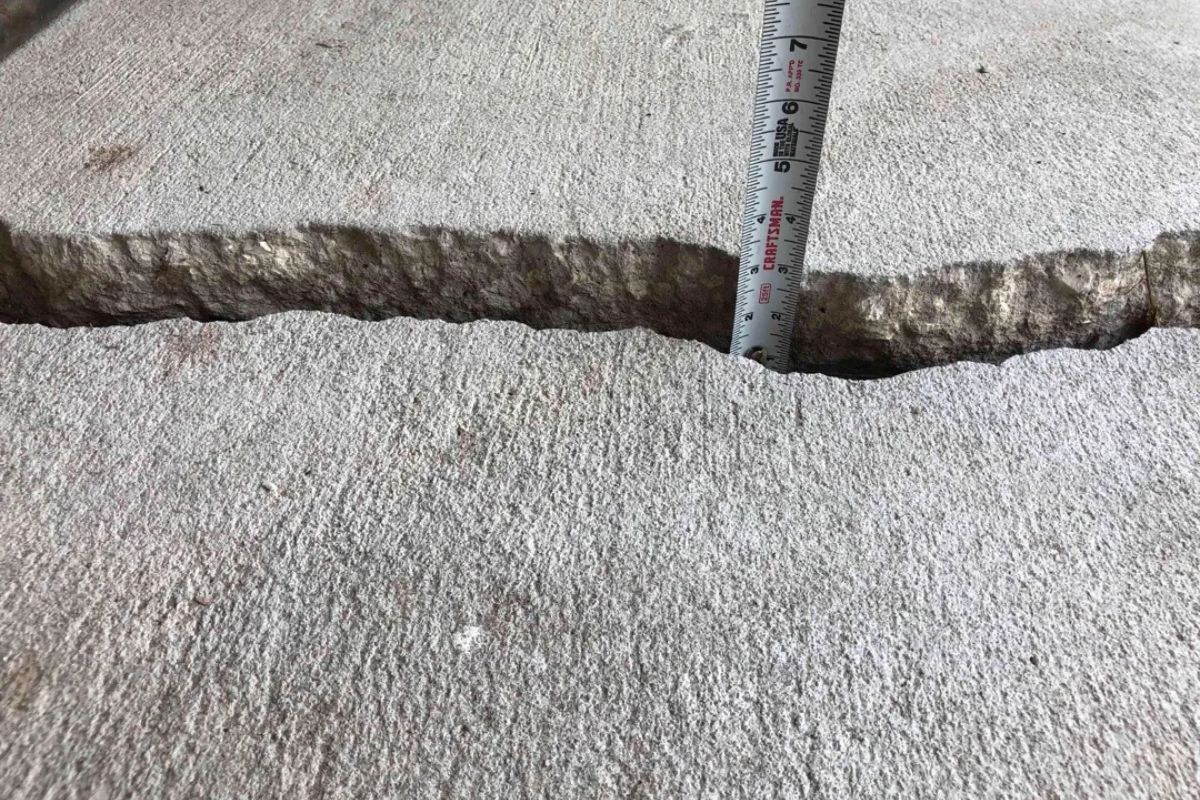
Hairline cracks — about the width of a credit card or less, with no vertical displacement (one side is not higher than the other). These are usually shrinkage cracks from when the concrete cured. They are common, they are generally not structural, and they can be sealed or simply monitored.
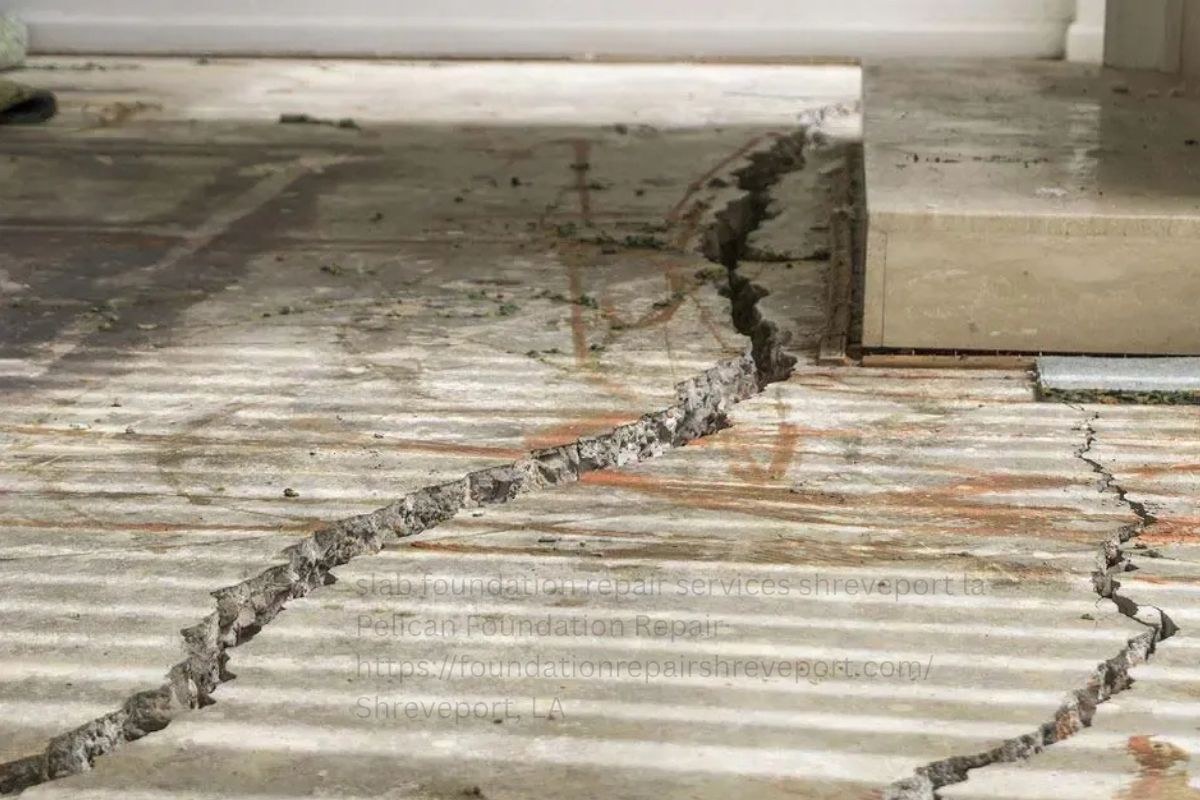
Wider cracks — if you can fit a coin in the crack, or one side of the slab sits higher than the other, that is movement, not shrinkage. Water coming up through a slab crack is another sign the crack goes all the way through and something is shifting below.
What the repair looks like. For a structural crack, the standard fix is epoxy injection: small ports set along the crack every several inches, low-pressure epoxy filling the full depth of the slab. When the crack is under stress, carbon-fiber stitching goes across it to keep it from reopening.
InterNACHI’s foundation inspection guidance recommends that cracks wider than about a quarter inch get evaluated by an expert, especially if walls or floors are also buckling. That matches what we see in the field — a quarter-inch crack in a slab is the line where “watch it” becomes “get it checked.”
One more thing worth knowing: sometimes a crack only becomes visible during a flooring project. Pull up old carpet or wood flooring and there it is, running across the slab underneath.
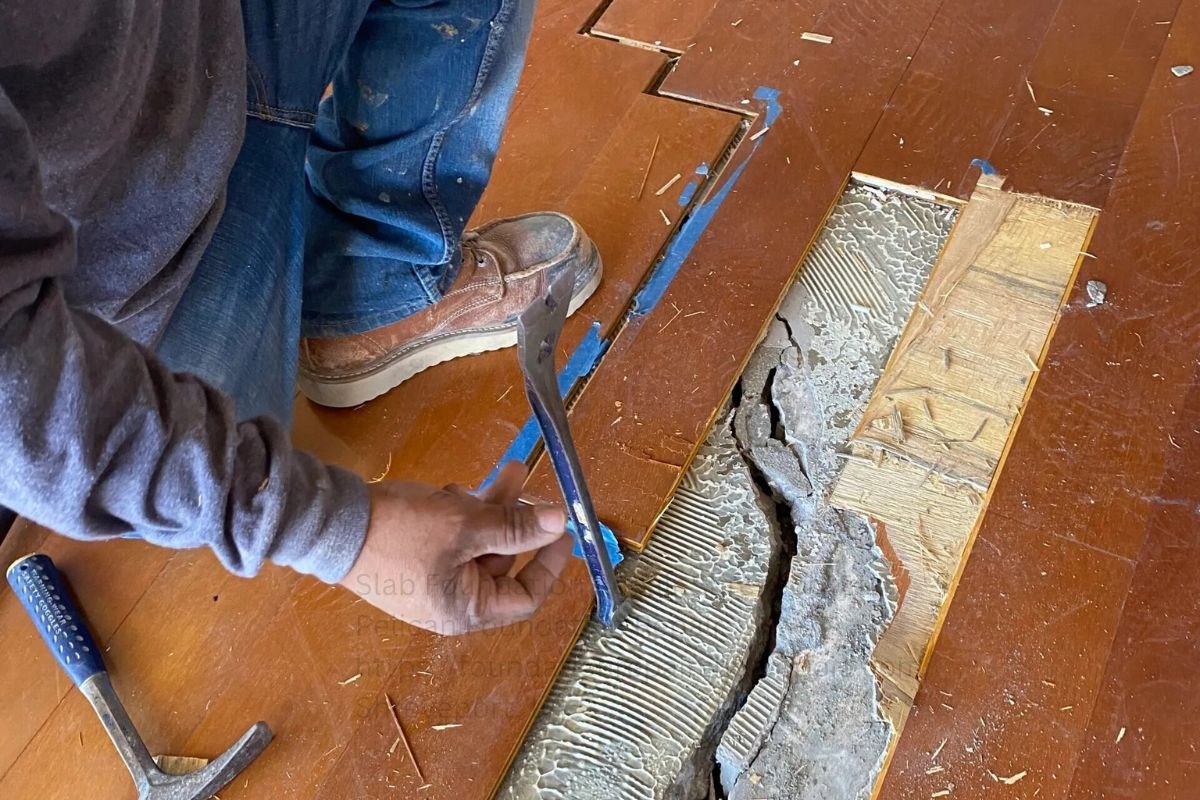
If you find one, note whether the edges are level, whether it is wet, and whether it has grown. That information makes an inspection much more productive.
Call (318) 585-2003 – Free Inspection
How Long Does Slab Foundation Repair Take?
Crack repair is usually a half-day job: set the ports, inject, clean up, done. You can walk on the area the same day.
A typical pier job runs two to four days. Day one is usually excavation and pier driving. Days two and three are lifting, plumbing coordination if needed, and backfill. Interior pier work adds time for cutting, dust control, and patching.
Tunneling is the wildcard. A short tunnel to reach one plumbing joint might add a day. An extensive tunnel network under a large slab can add several days. Your quote should spell out the timeline — if a contractor cannot tell you how many days your job takes, that is a red flag.
After the work, there is usually some cosmetic recovery: backfilled soil settles and may need topping off, and sod or landscaping along the excavation line needs attention. We see the same soil and slab patterns in Bossier City subdivisions as in Shreveport, and the timelines run the same there.
What Happens If You Wait
Slab problems do not stabilize on their own. The clay keeps cycling, the void keeps growing, and the costs move in one direction.
A $400 crack repair ignored for two years can become a $5,000 pier job once water moves through the crack and erodes soil. Doors stop closing, tile pops, and stressed plumbing joints start leaking — and a slab leak washes out the very soil holding your house up. It is a feedback loop, and it is expensive.
Water through slab cracks also brings moisture inside — musty smells, swollen baseboards, sometimes mold. Then you are paying for foundation repair and moisture remediation.
The cheapest slab repair is the early one. A new crack, a sticking door, a sloping floor — a free inspection now tells you exactly where you stand.
Call (318) 585-2003 – Free Inspection
Frequently Asked Questions
Can a slab foundation be repaired?
Yes, in most cases. Settled slabs are stabilized with steel push piers or helical piers driven to load-bearing soil, and cracked slabs are repaired with epoxy injection and carbon-fiber stitching. Only slabs that are shattered into separate pieces or have destroyed plumbing throughout are candidates for partial replacement instead.
How much does slab foundation repair cost near me in Shreveport?
Crack repair runs $400–$1,500 and full pier jobs run $3,500–$15,000+ in the Shreveport area. Interior pier work and tunneling trend toward the higher end. Pelican Foundation Repair offers free inspections, so you can get an exact quote for your home at no cost.
How do you fix a cracked slab foundation?
First the crack is evaluated for width and vertical displacement. Hairline shrinkage cracks can be sealed or monitored. Structural cracks are repaired with low-pressure epoxy injection through ports set along the crack, sometimes combined with carbon-fiber stitching across the crack to prevent reopening.
How long does slab foundation repair take?
Crack repair usually takes half a day. A typical pier stabilization job takes two to four days on site, depending on pier count and access. Tunneling for plumbing access can add days, and interior pier work takes longer than exterior work because of concrete cutting and patching.
Will the cracks come back after repair?
If the cause of the cracking is fixed — for example, the slab is stabilized on piers driven to load-bearing soil — structural cracks should not return. Hairline shrinkage cracks can occasionally reappear cosmetically as concrete continues to cure and Louisiana clay keeps cycling. Qualifying repairs from Pelican carry a 20-year structural warranty.
What is the best slab foundation repair method for Louisiana clay?
Piers driven to stable, load-bearing soil — below the active clay zone that swells and shrinks — are the reliable fix for settlement in expansive clay. Surface patches and cosmetic crack fills do not address the soil movement causing the problem. Drainage correction around the home also matters, since uncontrolled water accelerates clay cycling.
Get a Free Slab Foundation Inspection in Shreveport
If your slab is cracked, settling, or just making you nervous, the next step is simple and free. Pelican Foundation Repair inspects foundations across Shreveport and the surrounding parishes at no charge — no obligation, no sales pressure. You will get a straight answer about what is happening under your home and what it would cost to fix.
Call (318) 585-2003 — we are open Monday through Friday, 7:00 AM to 6:00 PM, and Saturday 8:00 AM to 2:00 PM. You can also reach us at contact@foundationrepairshreveport.com. The inspection is free either way.
Pelican Foundation Repair
6118 Fairfield Ave, Shreveport, LA 71106, USA
318-585-2003
https://foundationrepairshreveport.com/