 Skip to main content
Concrete Leveling Cost: Mudjacking vs Foam in Shreveport, LA
Concrete leveling cost in Shreveport runs about $4.80 per square foot for mudjacking-style work, with most residential jobs landing between a few hundred and a few thousand dollars. Foam leveling costs more but lifts more precisely and cures faster. Here is an honest breakdown of both methods — including when leveling is the wrong call entirely.
Foam jacking lifts faster and lasts longer, but mudjacking costs less; neither works if the soil underneath isn’t fixed or the slab is too far gone.
Call (318) 585-2003 – Free Inspection
📊 Mudjacking vs Foam at a Glance
1–2″ holes
Mudjacking drill size
~100 lbs/cu ft
Mudjacking slurry weight
Lightweight
Foam adds minimal load
What Is Concrete Leveling, Exactly?
Concrete leveling — also called slabjacking or slab leveling — is the process of raising sunken concrete back to its original position instead of tearing it out and replacing it. It is used on driveways, patios, walkways, garage floors, and pool decks: the flatwork around a house, not the foundation the house sits on.
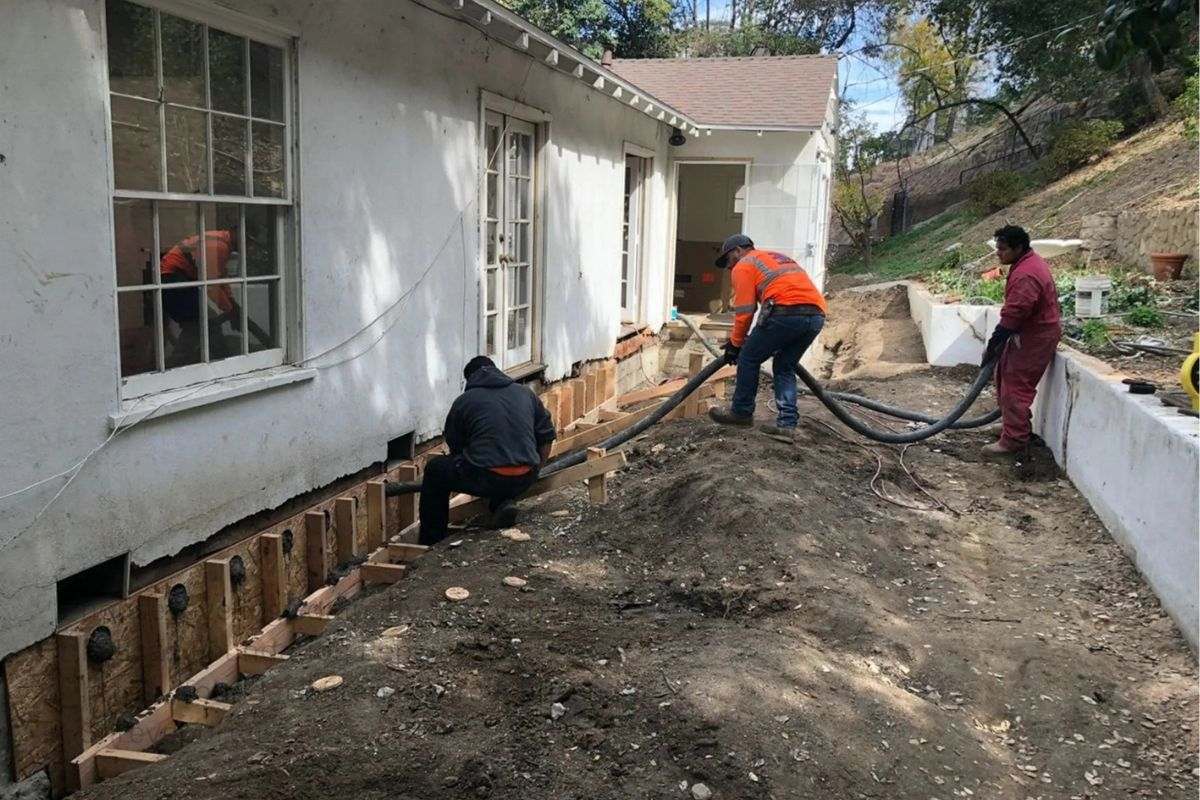
The process is straightforward. The crew drills holes through the sunken slab — about the diameter of a quarter for foam, closer to a golf ball for mudjacking slurry. Then they pump material underneath through those holes. As the voids fill, hydraulic pressure lifts the slab. The crew watches the lift against a level or laser, stopping when the slab is back where it belongs. Then the holes get patched.
On site, a mudjacking rig is a trailer with a mixer and pump pushing a soupy sand-cement slurry. A foam rig is smaller: two liquids mix at the gun, expand to fill voids, and harden within minutes. Both work — at different prices, with different tradeoffs.
One boundary: concrete leveling fixes sunken flatwork, not a sinking house. If the slab your home sits on is settling, that needs piers driven to load-bearing soil — our slab foundation repair page explains the work, and our slab repair cost breakdown covers pricing. Foam and mud cannot carry a house.
How Much Does Concrete Leveling Cost?
Reported concrete leveling cost in the Shreveport area runs about $4.80 per square foot for mudjacking-style work — a market reference, not a quote. Most residential jobs land between a few hundred dollars for a small walkway and a few thousand for a large driveway.
Polyurethane foam leveling typically costs more per square foot than mudjacking. The material itself is more expensive, and the equipment is more specialized. How much more depends on the contractor and the job — foam is a premium option, not a budget one. Branded polyurethane foam systems such as PolyLevel use the same basic two-part foam technology — judge any foam quote on scope, soil prep, and warranty terms, not the brand name on the truck.
What moves a concrete leveling quote around:
Square footage and lift height. A bigger area costs more, and a slab that needs to come up three inches needs more material than one that needs half an inch.
Void size. Sometimes the soil under a slab has washed out badly — a broken downspout or a leaking pipe can hollow out a surprising cavity. More void, more material, higher price.
Access. A driveway right off the street is easy. A backyard patio that the rig can barely reach, or a pool deck with tight clearances, takes more setup time.
Number of separate slabs. Mobilizing the crew and equipment is a fixed cost, and most companies have a minimum job charge — so one small walkway panel costs more per square foot than a whole driveway.
Slab condition. Cracked-but-intact slabs can usually be leveled. Crumbled, spalled, or heaved slabs cannot — replacement is the honest recommendation.
Call (318) 585-2003 – Free Inspection
Mudjacking vs Foam Jacking: Which Is Better?
This is the question every homeowner asks, and most of what you will read online is written by companies that only sell one of the two. Here is the straight version.
Mudjacking pumps sand-cement slurry under the slab through 1- to 2-inch holes. It is the older, cheaper method and works well on firm soil. The slurry is heavy — roughly 100 pounds per cubic foot — which is fine on solid ground but a drawback on soft, saturated soil, where the added weight can invite future settlement. The slab should not carry heavy loads for a day or more, and reported lifespan is typically 5 to 10 years.
Foam jacking pumps two-part polyurethane foam through dime-sized holes. It expands to fill voids, weighs only a few pounds per cubic foot, cures in about 15 minutes, and lifts more precisely in small increments. Reported lifespan is longer than mudjacking — often cited in decades.
But foam is not magic. On very loose or saturated soil it can flow into voids instead of lifting — we have seen a first round of foam disappear into a washed-out cavity. And some “lifetime warranty” marketing deserves skepticism: no material outlasts bad soil and bad drainage.
| Mudjacking | Foam jacking | |
|---|---|---|
| Material | Sand/cement slurry | Two-part polyurethane foam |
| Hole size | 1–2 inches | About 5/8 inch |
| Weight added | Heavy (~100 lbs/cu ft) | Light (a few lbs/cu ft) |
| Cure time | A day or more before heavy loads | About 15 minutes |
| Precision | Good | Excellent |
| Reported lifespan | Typically 5–10 years | Often longer, soil-dependent |
| Cost | Lower | Higher |
| Best for | Firm soil, budget-conscious jobs | Precise lifts, quick turnaround, weight-sensitive soil |
The honest answer: it depends on your soil, slab, and budget. On firm ground with a modest budget, mudjacking is a perfectly good repair. When you need precision, speed, or minimal added weight, foam earns its premium. Either way, the cause — drainage, erosion, a leaking pipe — must be fixed first. Neither method survives an active cause.
Pelican Foundation Repair offers concrete leveling for Shreveport-area flatwork, and we will tell you when leveling is not the right answer — including when the problem is actually your foundation.
How Long Does Concrete Leveling Last?
For mudjacking, the commonly reported lifespan is 5 to 10 years. For foam, manufacturers and contractors often claim much longer — decades, sometimes “lifetime.” Treat both numbers as starting points, not promises, because the real answer is: it lasts as long as the soil underneath stays put.
Think about why the slab sank in the first place. If a buried tree stump rotted out and left a void, or a one-time plumbing leak washed out soil that has since been repaired, the cause is gone — and leveling done on top of that fix can last a very long time with either method. The slab is sitting on stable ground again.
But if the cause is still active — expansive clay cycling through wet springs and dry summers, a downspout dumping at the slab edge, a growing tree root — the soil will move again and the slab will follow. The LSU AgCenter notes that Louisiana’s heavy clay soils swell when wet and crack open when dry — which is exactly why leveling without fixing the cause never holds. Foam’s longer reported lifespan does not save you; the ground wins regardless. Leveling also doesn’t fix street creep — the slow expansion of concrete slabs that pushes against foundations and neighboring slabs. That’s an expansion problem, not a settlement problem, and it needs a different solution.
That is why a good leveling job starts with the “why.” Fix the drainage, fix the leak, deal with the root — then level. In that order.
Call (318) 585-2003 – Free Inspection
Is It Cheaper to Level Concrete or Replace It?
Leveling is almost always cheaper. Reported mudjacking-style leveling runs about $4.80 per square foot here, while replacement — demolition, haul-off, forming, pouring, curing — usually costs several times more for the same area. Replacement also takes the slab out of service for days; leveled concrete, especially foam, is usable almost immediately.
But cheaper is not always smarter. Replacement is the right call when:
- The slab is crumbled or spalled — the concrete surface is flaking apart or the slab has broken into small pieces that cannot be lifted as a unit.
- Rebar is exposed or the slab is deteriorating from within. Lifting a dying slab just gives you a level dying slab.
- The slab has heaved (pushed up) rather than settled. Leveling lifts; it cannot push a heaved slab back down. Heave usually means cutting out and replacing, plus dealing with whatever is pushing it up — often a tree root.
- The slope is wrong. If a patio slopes toward the house, re-pouring with correct drainage slope solves two problems at once. Leveling can only adjust slope so much.
- The concrete is simply at the end of its life. A 40-year-old driveway that is cracked, pitted, and settled in five places is not a leveling candidate — it is a replacement candidate.
A straight contractor will tell you which category you are in. If someone tries to foam-jack a crumbled slab, get a second opinion.
Is Concrete Leveling Worth It?
Usually, yes — when the slab is otherwise sound. Here is the math most homeowners are doing:
Trip hazards and liability. A sidewalk or driveway panel that has settled an inch or two is a trip-and-fall waiting to happen. Leveling eliminates the hazard for a fraction of replacement cost. If the walkway is one the public uses, that alone justifies it.
Water against the house. A settled driveway that now slopes toward the foundation sends rainwater at your slab edge. In Shreveport’s spring downpours, that is a foundation problem in the making. Leveling restores the slope — and if the foundation itself is already moving, that is a separate job for piers.
Curb appeal and use. A level driveway you can actually use, a patio without the ankle-turner step, a pool deck without puddles — these are quality-of-life fixes with real payback when you sell.
When it is not worth it: when the slab is destroyed (see above), when the cause is unaddressed, or when the settled area is so small that the minimum job charge makes replacement of one panel comparable. A reputable company will say so.
Call (318) 585-2003 – Free Inspection
When Leveling Is the Wrong Fix
There are three situations where we talk homeowners out of leveling:
1. The house itself is settling. Sticking interior doors, sloping floors, cracks through the slab the house sits on — foam under the driveway will not help. That is foundation settlement and needs piers. Leveling flatwork around a sinking house is decorating around a structural problem.
2. An active leak is washing out soil. A broken sewer line or water line under a driveway will keep eroding soil no matter how much material gets pumped in. The plumber goes first, the leveling crew second. Any contractor who skips this question is guessing.
3. Tree roots are heaving the slab. If a root has lifted a sidewalk panel, pumping material underneath does not remove the root. The root keeps growing, the slab keeps rising, and you have paid for a repair that cannot hold. Root barrier, root pruning, or tree removal comes first — then the concrete work.
We would rather lose a leveling job than sell one that fails in a year. If an inspection shows your problem is really a foundation issue, we will tell you that and quote the foundation work instead.
Best Season for Concrete Leveling in Louisiana
The best season for concrete leveling in northwest Louisiana is the drier stretch — late summer through fall. By then, the spring rains have passed, the clay has settled into its dry-season position, and voids under slabs are at their most visible. Leveling done on settled, dry-season soil gives you the truest lift.
Leveling can still be done year-round: foam cures in minutes at any temperature, and Shreveport rarely freezes. The one caution is timing a job right after heavy spring storms — saturated soil is still moving, and a slab leveled on Monday can shift again by Friday. A good crew will tell you if conditions are wrong.
One note for rural properties around Keithville and south Caddo Parish: long driveways on expansive clay are leveling candidates more often than people expect.
Call (318) 585-2003 – Free Inspection
Frequently Asked Questions
Mudjacking vs foam jacking — which is better?
Neither is universally better. Mudjacking costs less and works well on firm, stable soil. Foam jacking lifts more precisely, cures in about 15 minutes, uses nearly invisible holes, and adds almost no weight — but costs more. What matters most is fixing the cause of settlement (drainage, leaks, soil) before leveling with either method.
How long does concrete leveling last?
Mudjacking is commonly reported to last 5 to 10 years; foam is often reported to last longer. Actual lifespan depends on the soil underneath: if the cause of settlement is fixed, leveling can last a very long time, but active clay movement, drainage problems, or leaks will shorten the life of either method.
Is it cheaper to level concrete or replace it?
Leveling is almost always cheaper — reported mudjacking-style leveling runs about $4.80 per square foot in the Shreveport area, while full replacement with demolition and new concrete typically costs several times more for the same area. Replacement is the better choice when the slab is crumbled, heaved, or at the end of its life.
What is the best season for concrete leveling?
Late summer through fall is ideal in northwest Louisiana, when soils have settled after spring rains and voids are most visible. Leveling can be done year-round, but it is worth waiting a few weeks after heavy storms rather than leveling on saturated, still-moving soil.
How much does concrete leveling cost per square foot?
Reported concrete leveling cost in the Shreveport area is about $4.80 per square foot for mudjacking-style work. Foam jacking costs more per square foot. Small jobs cost more per square foot than large ones because most companies have a minimum job charge.
Can concrete leveling fix my sinking house foundation?
No. Concrete leveling raises sunken flatwork like driveways and patios; it cannot carry the weight of a house. A settling home foundation needs steel piers driven to load-bearing soil. If your house itself is settling — sticking doors, sloping interior floors — get a foundation inspection instead.
What is the difference between mudjacking and polyurethane?
Mudjacking pumps a heavy sand-cement slurry under the slab through 1- to 2-inch holes — it costs less, but adds about 100 pounds per cubic foot and needs a day or more before the slab should carry heavy loads. Polyurethane is a two-part foam pumped through dime-sized holes — it weighs only a few pounds per cubic foot, cures in about 15 minutes, and lifts more precisely, but the material costs more. With either method, the cause of the settlement has to be fixed first.
Get a Free Inspection Before You Level Anything
If your driveway, patio, or walkway has settled, the first step is figuring out why — because the “why” decides whether leveling will hold. Pelican Foundation Repair inspects Shreveport-area properties for free and will tell you honestly whether leveling, drainage work, or something else is the right fix.
Call (318) 585-2003 — Monday through Friday, 7:00 AM to 6:00 PM, and Saturday 8:00 AM to 2:00 PM. Or email contact@foundationrepairshreveport.com. The inspection costs nothing, and the straight answer is worth a lot.
Pelican Foundation Repair
6118 Fairfield Ave, Shreveport, LA 71106, USA
318-585-2003
https://foundationrepairshreveport.com/