 Skip to main content
Steel Push Piers vs Helical Piers: Which Is Right for Your Shreveport Home?
Both push piers and helical piers stabilize sinking foundations by transferring your home’s weight to load-bearing soil. Push piers are hydraulically driven down using the structure’s weight as resistance; helical piers screw into the ground like screws and suit tight-access spots. In Shreveport, full pier jobs typically run $3,500 to $15,000+, depending on pier count and soil conditions.
Neither pier type is universally better — helical piers suit tight access and lighter loads, while push piers use your home’s weight to reach deep load-bearing soil.
Call (318) 585-2003 – Free Inspection
📊 Push Piers vs Helical Piers at a Glance
2 pier types
Steel push vs helical — compared head-to-head
Below the clay
Both anchor in deep, stable soil
Free
Inspection determines the right fit
How Do Steel Push Piers Work?
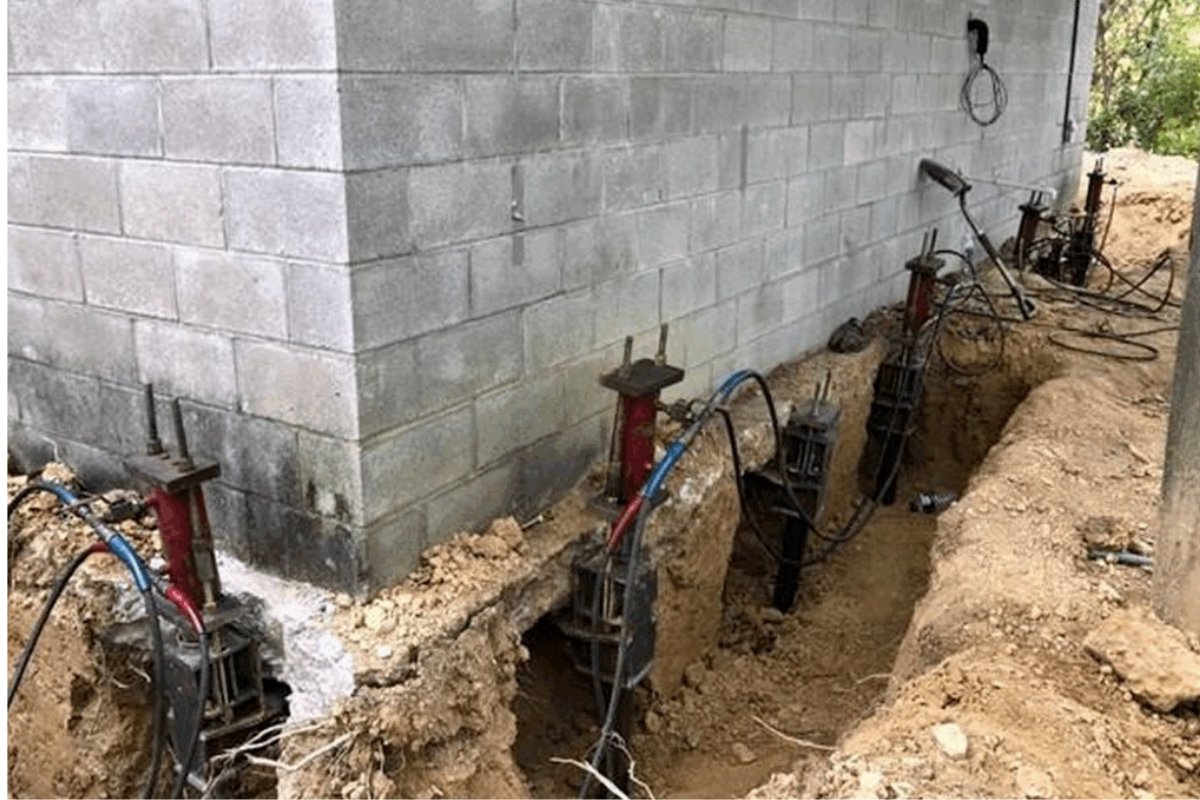
A steel push pier — sometimes called a resistance pier — is heavy steel pipe driven straight down alongside your foundation to load-bearing soil or rock. The crew excavates a small pit at each location, attaches a steel bracket under your concrete footing, and a hydraulic ram pushes pier sections down one after another, using your house’s own weight as the resistance.
The ram keeps driving until the soil pushes back harder than the building weighs — engineers call this “refusal.” The pier is now on strata strong enough to carry the structure. The crew then uses the hydraulics to lift the settled foundation back toward level, and the bracket locks it in place.
On site, you know a push pier is doing its job when the pressure gauge on the hydraulic pump climbs and holds steady as each section goes down. In Caddo Parish, we often drive through several feet of soft, wet clay before the gauge jumps — that sudden resistance is the pier biting into dense sandy clay or a harder bearing layer. When the gauge holds at the target pressure and the pier stops advancing, you have got a support you can trust.
How Do Helical Piers Work?
A helical pier looks like a giant screw — a steel shaft with one or more helix-shaped plates welded to it. Instead of being pushed, it is rotated into the ground with a hydraulic torque motor, screwing down through the soil until it reaches the required depth and load capacity.
The helix plates pull the pier downward as it turns, then bear against the soil to carry the structure’s weight. A steel bracket connects the pier to your footing, just like with push piers.
Installers know a helical pier is deep enough by monitoring torque — the harder the ground fights the rotation, the more weight that pier can support. The crew stops when readings hit the engineered specification for your home.
Helical piers need far less excavation: they screw in from above with a compact drive head, fitting under porches, beside tight lot lines, and even inside through a small slab hole. That low-impact installation is their signature advantage.

Call (318) 585-2003 – Free Inspection
Steel Push Piers vs Helical Piers: Side-by-Side Comparison
Here is how the two systems stack up on the factors that actually matter for your home:
Some national companies also sell proprietary hybrid systems — Olshan’s Cable Lock ST Plus, for example, combines steel and concrete piling — but the underlying mechanics still come down to driven piers reaching stable bearing soil, so the same comparison factors apply.
| Factor | Steel push piers | Helical piers |
|---|---|---|
| Installation method | Hydraulically pushed straight down | Screwed in with a torque motor |
| Reaction force | Uses the building’s own weight | Uses torque resistance of the soil |
| Depth verification | Pressure gauge at refusal | Torque readings vs. engineering spec |
| Excavation needed | Pit dug at each footing location | Minimal — small entry point |
| Tight-access work | Difficult under porches/slabs | Excellent — fits tight spaces |
| Best for heavy structures | Yes — more weight means deeper drive | Works, but sized carefully |
| Best for light structures | Can struggle — not enough weight to push against | Yes — doesn’t need building weight |
| Lifting capability | Strong — jacks lift off the bracket | Strong — jacks lift off the bracket |
| Typical residential timeline | 1–3 days | 1–3 days |
Notice what is missing from that table: a winner. There isn’t one. The right pier is the one that matches your soil, your structure’s weight, and your access constraints. Any contractor who tells you one system is always better is selling you their inventory, not a solution.
Which Pier Type Works Best in Louisiana Clay Soil?
Northwest Louisiana soil is the great decider here, and it deserves an honest explanation.
Our ground is expansive clay for the first several feet — the sticky red-orange soil that swells in spring rains and shrinks in the August drought. Below that clay, you typically find denser sandy clay, and eventually sand or harder bearing strata. Both pier types are designed to bypass the troublesome upper clay and bear on the stable stuff below. They just get there differently.
Push piers need enough structure weight to drive through that clay to refusal — no problem on a heavy two-story brick home, but a light frame house may not provide enough resistance at every location.
Helical piers don’t need building weight, since torque drives them. In soft, wet clay near the Red River, the helices can spin without building torque quickly — they simply go deeper to find the specified capacity. That is the system working as designed.
The LSU AgCenter’s expansive soil resources explain why our clay behaves this way — worth reading before you sign anything.
Call (318) 585-2003 – Free Inspection
Can Helical Piers Lift a House?
Yes — despite the common misconception that helical piers only stabilize, they absolutely can lift.
Once torqued to spec, the installer mounts a lift bracket and uses hydraulic jacks to raise the settled section in controlled stages. Whether you get a full or partial lift depends on the settlement and the structure’s condition — lifting too fast can crack finishes and stress framing.

How Deep Do Helical Piers Go?
There is no standard depth, and any contractor who quotes you one before testing your soil is guessing.
Helical piers go as deep as your soil requires — the crew keeps screwing sections on until the torque readings meet the engineered load specification. In the Shreveport area, that often means somewhere in the range of 10 to 25 feet, but depth is determined on site by instrument readings, never by a preset number.
Call (318) 585-2003 – Free Inspection
What Are the Disadvantages of Helical Piers?
Here are helical piers’ real limitations:
They can cost more in deep-soil situations — extra shaft sections add cost where clay forces deep installation.
Soft soils slow them down — helices can churn in saturated ground without building torque, requiring deeper installation.
They need skilled torque interpretation — reading the instruments correctly takes training, not eyeballing.
Corrosion must be addressed. Any steel in Louisiana’s wet soil needs proper galvanizing or coating — ask what corrosion protection is included, in writing.
They are not ideal for every load. Extremely heavy commercial loads on poor soil may favor other methods; for typical residential work, properly engineered helical piers handle the job.
None of these are disqualifiers — the right contractor accounts for all of them in the design before installation.
How Much Does Push Pier Installation Cost?
Full pier jobs in the Shreveport area typically run $3,500 to $15,000 or more — that range covers both push piers and helical piers, since total project cost is driven far more by the scope of work than by which pier type you choose.
What moves a pier job up or down within that range:
Pier count. A settling corner might need four to six piers; a full dropped perimeter could need twenty or more.
Depth. Deeper bearing soil means more steel and more labor per pier.
Access. Exterior piers on an open lawn go fast; interior piers through a slab or under a porch go slow — access is one of the biggest hidden cost drivers.
Plumbing and utilities. Lines in the work zone must be located and protected — and repaired if settlement damaged them.
The lift itself. Stabilization and lifting are different scopes — lifting adds hydraulic work, monitoring, and sometimes cosmetic repair.
We don’t publish per-pier prices — what matters is the engineered plan and the total project price in writing. Our breakdown of foundation repair costs in Shreveport covers how pier work fits into the bigger pricing picture, and a free foundation inspection is how you get real numbers for your home.

Call (318) 585-2003 – Free Inspection
How Long Does It Take to Install Helical Piers?
Most residential helical pier jobs finish in one to three days — a small corner job often in a single day, a full-perimeter or interior installation in two to three.
Timelines stretch with poor access, deep bearing soil, weather delays, and the lift itself, which proceeds in slow, measured stages. A crew that rushes the lift is a crew you don’t want.
Foundation Underpinning in Shreveport: When Access Decides the System
In practice, the soil-vs-weight debate settles a lot of jobs — but access settles the rest.
A brick home in Highland with settlement under the front porch: excavating push-pier pits under the slab is destructive, while helical piers can go through small core holes. A Keithville home with a dropped interior slab near a load-bearing wall: helical piers driven from inside avoid tearing up the yard.
Flip it: a heavy two-story on an open lot in Stonewall or Benton with full perimeter access is textbook push-pier territory.
That is foundation underpinning as actually practiced — a site-specific decision weighing soil, structure weight, access, and settlement pattern.
Call (318) 585-2003 – Free Inspection
Which Should You Choose? A Simple Decision Framework
Use this as a starting point — your inspection will confirm or redirect:
- Heavy two-story brick home, open access around the perimeter, settlement on the exterior walls → push piers are often the natural fit.
- Light single-story or frame structure, tight lot, settlement under porches, patios, or interior walls → helical piers often win on access and don’t need building weight.
- Very soft or saturated soil requiring deep bearing → either can work; get both designed and compare total project cost.
- You need lifting, not just stabilization → both systems lift; the question is which installs cleanly at your problem locations.
- Still unsure → that is exactly what the inspection is for.
Don’t price-shop per-pier quotes from contractors who sell only one system. Work with one contractor who installs both and recommends what fits your house. Pelican Foundation Repair installs and services both steel push piers and helical piers across Shreveport, Keithville, Bossier City, and the surrounding parishes.
You can read the technical details of each method on our service pages: steel push pier installation and helical pier installation.
Frequently Asked Questions
How much does it cost to have helical piers installed?
Full pier jobs in Shreveport typically run $3,500 to $15,000 or more, whether helical or push piers. Cost depends on pier count, depth to bearing soil, access, and whether lifting is included. A free inspection produces an engineered plan with a written total price.
Can helical piers really lift a house, or just stop it from sinking?
They can do both. Once torqued to specification, lift brackets and hydraulic jacks raise the settled foundation in controlled stages. Whether full or partial lift is appropriate depends on the amount of settlement and the structure’s condition.
How deep do helical piers need to go?
As deep as your soil requires — installation continues until torque readings meet the engineered load specification. In the Shreveport area that is often 10 to 25 feet, but depth is determined on site by instrument readings, never by a preset number.
What are the disadvantages of helical piers compared to push piers?
In deep-soil situations they can cost more due to extra shaft sections, very soft saturated soil slows torque buildup, and the system depends on skilled torque interpretation. Push piers can be more economical on heavy structures with open access where the building’s weight drives them to refusal.
How long does helical pier installation take?
Most residential jobs finish in one to three days. Small corner jobs often complete in a day; full-perimeter or interior installations with deep drives can take two to three days. Steel piers carry load immediately, so there is no curing wait.
Do push piers work on light houses?
Sometimes, but it’s their weak spot. Push piers use the structure’s weight to drive to bearing soil — a light frame house may not provide enough resistance at every location. Helical piers don’t need building weight, so they often fit lighter structures better.
Will the piers come with a warranty?
Ask for the warranty in writing before you sign. Pelican Foundation Repair backs qualifying repairs with a 20-year structural warranty, and your written quote will spell out exactly what is covered for your pier scope.
Do I need an engineer, or is a contractor’s inspection enough?
A qualified contractor’s inspection is enough for most residential pier work — the design follows established specs based on torque or pressure readings. For complex structural issues or commercial buildings, an independent structural engineer’s report is worth the investment.
Do push piers or helical piers cost more?
For most residential jobs, total project cost is driven by scope — pier count, depth, and access — not by which pier type you choose. In deep-soil situations, helical piers can cost more because every extra shaft section adds material and labor. On heavy structures with open access, push piers can be the more economical option. Get both designed for your house and compare total written project prices.
What are the pros and cons of push piers vs helical piers?
Push piers: pros — they use the building’s weight to reach deep bearing soil, lift strongly, and are often economical on heavy structures. Cons — they need enough structure weight at each location, require excavation pits, and fit poorly in tight-access spots. Helical piers: pros — they screw in with minimal excavation, fit tight spaces and light structures, and don’t need building weight. Cons — they can cost more in deep soil, depend on skilled torque interpretation, and need proper corrosion protection in wet soil.
What is a push pier?
A push pier — also called a resistance pier — is a heavy steel pipe hydraulically driven straight down alongside your foundation until it reaches load-bearing soil or rock, using your home’s own weight as the resistance the ram pushes against. A steel bracket connects the pier to your footing, and hydraulic jacks can then lift the settled foundation. Push pier steel is galvanized or coated to resist corrosion in wet Louisiana soil — ask what is included, in writing.
Call (318) 585-2003 – Free Inspection
Get a Free Foundation Inspection in Shreveport
Push piers, helical piers, or something else entirely — the answer is under your house, not in a brochure. Pelican Foundation Repair offers free inspections across Shreveport and the surrounding areas. We will evaluate your soil conditions, measure the settlement, explain which system fits your home and why, and give you a written quote with no pressure. Call (318) 585-2003 today. We are open Monday through Friday, 7:00 to 6:00, and Saturday 8:00 to 2:00.
Pelican Foundation Repair
6118 Fairfield Ave, Shreveport, LA 71106, USA
318-585-2003
https://foundationrepairshreveport.com/