 Skip to main content

Can I Install Helical Piers Myself? Why DIY Piering Fails
No — helical piers need engineered designs, torque monitoring, and heavy equipment that DIYers cannot rent or fake. Here is exactly why, and what goes wrong when people try.
Can you install helical piers yourself? Honestly, no. Each pier must be screwed to a specific torque that matches an engineer’s load calculation for your soil, using a hydraulic drive head on an excavator or skid steer. Without the engineering, the torque data, and the equipment, a DIY pier is a guess holding up your house — and guesses fail.
Plenty of foundation work has a legitimate DIY tier — grading, drainage, crack monitoring, even some concrete patching. Helical piers are not in that tier, and the reasons are specific. This post lays them out: the equipment, the engineering, where DIY attempts break down, and what you can usefully do yourself instead.
If a quote surprised you, that is a fair reason to ask — piers are real money. But a failed DIY pier job plus the full professional redo is the most expensive version of this project. Read the whole thing before you price out a rental auger.
The Short Answer, With Respect
If you are handy enough to ask this seriously, you are handy enough to understand why the answer is no. A fence post holds up a fence. A helical pier holds up a corner of your house for decades, through wet springs and dry late summers in Shreveport’s swelling clay, without moving more than the design allows.
That job has three non-negotiable parts: the right equipment, the engineering that sizes and places each pier, and the torque data that proves each pier reached load-bearing soil. A homeowner can realistically obtain none of the three at the standard a house requires. The sections below explain each one, because “trust us, hire a pro” is not an argument — it is a sales pitch. You deserve the actual reasons.
What a Helical Pier Actually Is
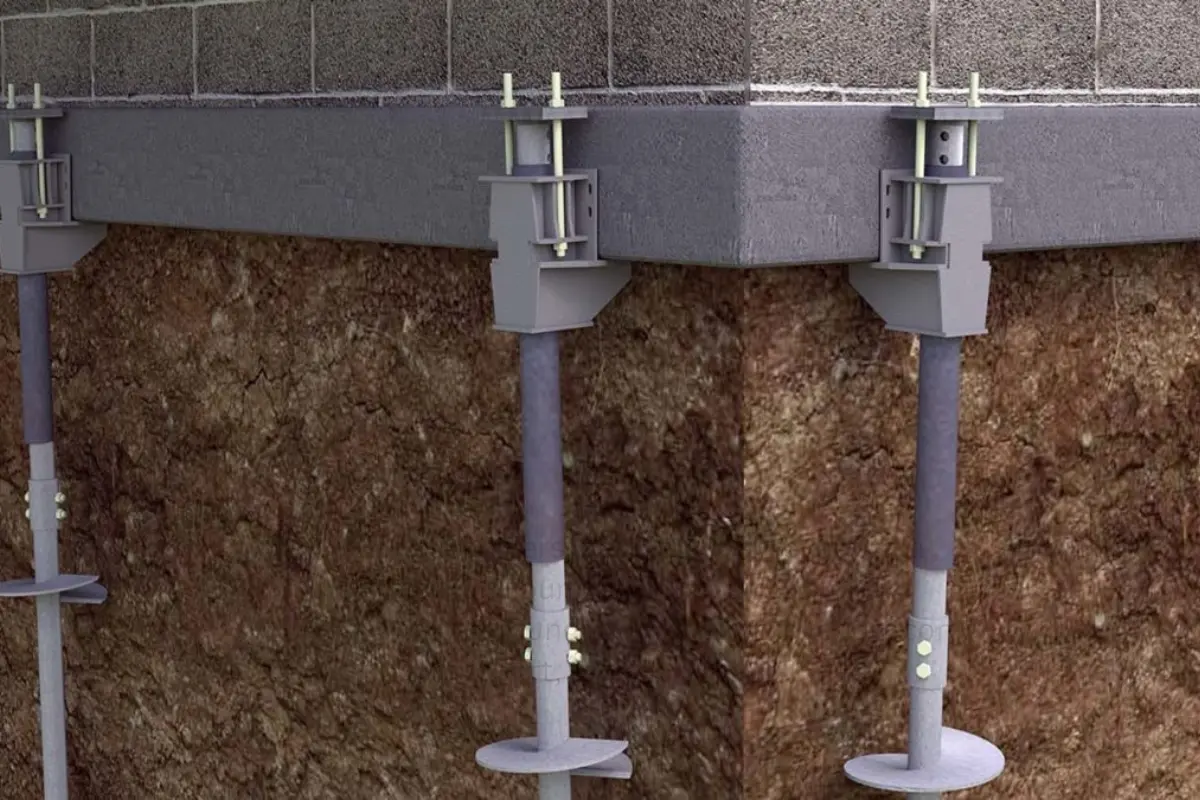
A helical pier looks simple: a steel shaft with one or more helix-shaped plates welded near the bottom, like a giant screw. The crew drives it into the ground by rotating it, and the helix plates pull it down until they bite into stable, load-bearing soil — often far below the shifting surface clay. A steel bracket then connects the top of the pier to the foundation, transferring the house’s weight down past the problem soil to the stable layer.
The simplicity is deceptive. Everything that makes the system work is invisible: how deep the helix has to go, how much torque proves it is bearing on the right layer, how many piers the load requires, and where exactly each one goes. Those answers come from soil data and load calculations, not from the pier itself. The hardware is the easy part. Knowing where to put it, how deep to drive it, and when to stop is the entire job — and it is the part you cannot improvise.
In the Shreveport area, that stable layer sits below the active clay zone that swells every spring and shrinks every August. The U.S. Geological Survey maps expansive soils across this region — but each property still gets its own engineering, because soil changes lot to lot, sometimes within a single yard.
The Equipment Problem
Helical piers are installed with a hydraulic drive head — a torque motor mounted on an excavator or skid steer — that rotates the pier into the ground while a gauge reads the installation torque in real time. That torque reading is the whole quality-control system: the crew watches resistance climb as the helix moves through soft soil, and stops when the numbers prove the pier has reached the designed bearing layer.
Here is why that stops a DIY project cold:
- You cannot rent the right drive head as a homeowner. The torque motors sized for foundation piers are specialized attachments, and the rental market does not stock them for walk-in customers. A fence-post auger or a handheld driver does not produce anything close to the required torque.
- The machine matters. The drive head needs a stable excavator or skid steer to react against the torque. Without that reaction force, the machine spins instead of the pier — dangerous, and useless.
- The gauge is the job. Even if you found the hardware, installing without calibrated torque monitoring means installing blind. You would have no way to know whether a pier reached bearing soil or just stopped in dense clay six feet short.
- The brackets are engineered components. The foundation bracket that ties the pier to the house is a manufactured, load-rated part, not something to fabricate. It has to be set and loaded correctly, or the connection fails under the house’s weight.
A pier installed without torque verification is not a pier. It is a steel rod in the ground, and a steel rod in the ground holds up nothing.

The Engineering Problem
Before the first pier goes in, an engineer determines four things: how many piers, where each one goes, how deep each must reach, and what torque proves it got there. Those answers come from the house’s loads and the soil’s behavior — and in northwest Louisiana, the soil is the tricky half of the equation.
| What Engineering Determines | Why You Cannot Guess It |
|---|---|
| Pier locations and spacing | Load paths through the foundation are calculated from the structure above. Wrong spacing overloads some piers and wastes others. |
| Required depth per pier | The bearing layer depth varies across a single lot in Shreveport clay. Depth is verified by torque, not assumed. |
| Target installation torque | Torque correlates to load capacity through tested engineering relationships. “Deep enough” is a number, not a feeling. |
| Helix size and shaft strength | Sized to the loads and soil resistance. Undersized hardware bends or fails under installation torque. |
Depth deserves a special note because it surprises people. Piers on the same house routinely end up at different depths — one might bear at fifteen feet, the next at twenty-five — because the bearing layer is not flat. Our guide to how deep helical piers go explains why, and it is the single best argument against DIY: if depth varies pier to pier and only torque data reveals it, there is no version of this job where guessing works.
How DIY Piering Actually Fails
People do try this, usually with rented augers, improvised drivers, or screw piles meant for decks and sheds. The failures follow a pattern:
| What Goes Wrong | Why It Happens |
|---|---|
| Piers stop in the active clay zone | Without torque data, “hard to turn” feels like “deep enough.” The pier bears on swelling clay and moves with the seasons. |
| Uneven support across the foundation | Piers at different depths with different capacities, placed by guesswork, load the foundation unevenly and can crack it. |
| Undersized hardware for house loads | Deck and shed screw piles are not foundation piers. House loads bend or shear hardware that was never rated for them. |
| Damaged utilities and drainage | Pros locate utilities and plan around them. A homeowner driving steel blind risks water, gas, and sewer lines. |
| No way to verify any of it | Without torque logs, there is no record that any pier reached bearing soil — which matters for the next section. |
The worst part is the delay. A bad DIY pier job can look finished. The house sits on the new piers, everything feels solid, and the settlement continues quietly for a year or two before the symptoms return — except now the foundation has been loaded unevenly, and the professional fix is harder than the original job would have been.
The Money, Liability, and Resale Problem
DIY piers create problems that outlive the project. No manufacturer warranties a pier installed by an uncertified homeowner — the 20-year structural warranties on qualifying professional repairs do not exist for DIY work. If a pier fails, the redo lands entirely on you.
Then there is the house itself as an asset. Louisiana sellers disclose foundation work, and “piers installed by homeowner, no engineering, no permits, no torque records” is the kind of disclosure that kills deals or triggers lender demands for a professional evaluation — which usually ends with a recommendation to redo the work properly. Homeowners insurance can also take a dim view of unpermitted structural modifications. The money you saved on installation comes back as lost sale value, and then some.
Permits are the quiet part of this. Structural foundation work in Shreveport and Bossier City typically requires permits and inspections, and permitted work requires licensed contractors. An unpermitted pier job is a liability you own until the day you sell — and then it becomes the buyer’s problem, which is exactly why buyers walk away from it.
What You CAN Do Yourself
The piers are off the table, but plenty of useful work around a piering project is firmly in the homeowner’s lane — and doing it well makes the professional job cheaper and more effective:
- Monitor and document: photograph cracks with a ruler for scale, date the photos, and note which doors stick and when. This record helps the engineer and proves whether movement is active.
- Fix the water: clean gutters, extend downspouts well past the foundation, and regrade soil to slope away from the house. In Shreveport’s wet springs, drainage correction sometimes slows settlement enough to change the scope of the pier plan.
- Clear the work area: move landscaping, stored items, and obstacles away from the foundation perimeter before the crew arrives. Access saves labor hours.
- Get educated quotes: learn what the job involves — our honest look at helical pier disadvantages is a good start — so you can compare bids intelligently instead of shopping on price alone.
Think of yourself as the project manager, not the installer: ask about torque targets, read the engineering, hold the contractor to the plan. That is a real and valuable role — it just does not involve operating the drive head.
What Professional Installation Actually Looks Like
For contrast, here is the real sequence. An engineer sizes the pier layout and sets torque targets. The crew excavates small pits, mounts the hydraulic drive head on the excavator, and screws each pier down while logging torque continuously — stopping only when the reading proves bearing. Then the bracket is attached, the load transferred with hydraulic jacks, and the pits backfilled.

You get the engineering report, the torque logs for every pier, and the warranty in writing. That documentation package is the difference between a repair and a guess: it proves the work, it transfers to the next owner, and it is what the price actually buys. Our steel push and helical pier installation services follow exactly this process, and every project starts with a free inspection — Pelican Foundation Repair, Monday through Saturday, 8:00 AM to 6:00 PM.
Frequently Asked Questions
Can I install helical piers myself?
Honestly, no. Proper installation requires engineered pier placement, a hydraulic drive head on heavy equipment, and continuous torque monitoring to prove each pier reached bearing soil. None of the three is available to a homeowner at the standard a house requires.
Why can’t I just rent the equipment for helical piers?
The hydraulic torque motors sized for foundation piers are specialized attachments that rental yards do not stock for homeowners, and the machine has to be heavy enough to react against the torque. A fence-post auger cannot substitute.
What is installation torque, and why does it matter?
Installation torque is the rotational resistance measured as the pier screws down. Through tested engineering relationships, torque correlates to the pier’s load capacity — it is how the crew proves each pier reached stable bearing soil instead of just stopping in dense clay.
Are there any foundation piers a homeowner can install?
Small screw piles rated for decks, sheds, and light structures are sold to homeowners, but they are not foundation piers and cannot carry house loads. Nothing rated for a house is a DIY product.
What happens if DIY piers fail?
Settlement continues, often unevenly, which can crack the foundation worse than before. There is no manufacturer warranty on homeowner-installed piers, and the professional redo typically costs more than the original job would have.
Do helical piers need permits in Shreveport?
Structural foundation work generally requires permits and inspections locally, and permitted work requires licensed contractors. Unpermitted structural work becomes a disclosure and resale problem.
How much does professional helical pier installation cost?
Residential piering commonly runs $1,000 to $3,000 per pier installed, with most houses needing a set of piers priced as a project. The engineering, equipment, torque verification, and warranty are what the price covers.
Will DIY piers affect selling my house?
Yes, negatively. “Homeowner-installed piers, no engineering or permits” in a disclosure scares buyers and lenders, and often triggers a demand for a professional evaluation that recommends redoing the work.
Pelican Foundation Repair
6118 Fairfield Ave, Shreveport, LA 71106, USA
318-585-2003
https://foundationrepairshreveport.com/