 Skip to main content


Helical Piers for Commercial Buildings in Shreveport: When Engineers Spec Them
Engineers specify helical piers for Shreveport commercial buildings when the job needs low vibration, tight access, and fast installation. Here is how they work and when they are right.
Engineers specify helical piers for Shreveport commercial buildings when the project has constraints other methods can’t handle: the building stays open during work, there’s no room for big equipment, or the surface soil can’t carry the load. Helical piers screw into stable soil with minimal vibration, a natural fit for occupied buildings.
If you own or manage a commercial property in Northwest Louisiana and you’ve heard the term “helical piers” from an engineer, a contractor, or a building inspector, this guide explains what they are, why engineers choose them over alternatives, and what a typical commercial installation looks like. No hype, no invented claims, just how the technology works in real Shreveport conditions.
What a Helical Pier Actually Is
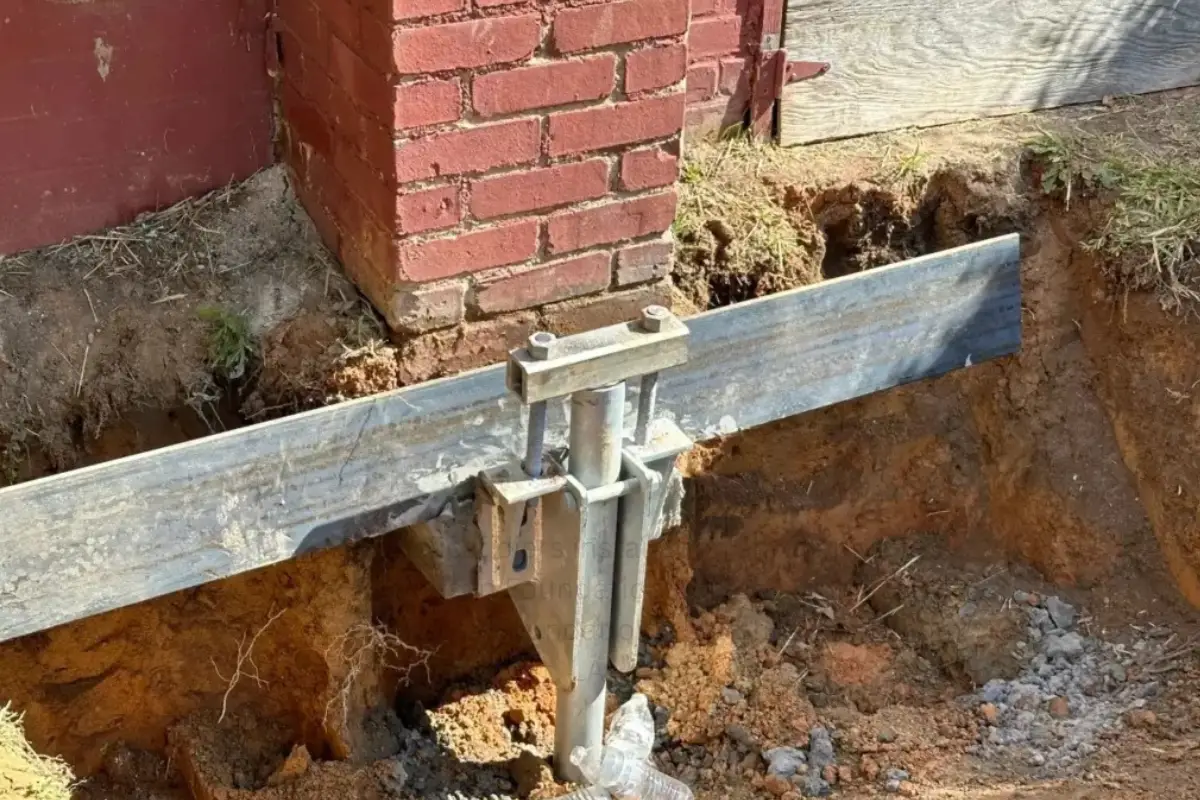
A helical pier looks like a giant steel screw. It has a central steel shaft with one or more helix-shaped plates welded along it. A hydraulic drive head rotates the pier into the ground, and the helices pull it downward like a screw pulling into wood. Installation stops when the pier reaches soil strong enough to carry the design load, which the installer verifies by measuring the torque required to turn it.
That torque measurement is the key to the whole system. Because the installer knows how hard the pier is working as it goes in, the capacity of each pier is verified during installation, not guessed at afterward. The building’s weight is then transferred from the weak surface soil to the pier, and from the pier to the deep, stable soil it reached.
On a commercial building, piers typically connect to the structure through steel brackets. For an existing building that’s settling, the bracket attaches to the existing footing, and the pier lifts and holds the footing. For new construction, piers connect to grade beams or pile caps that carry the building’s columns and walls.

Why Engineers Spec Helical Piers for Commercial Work
Engineers don’t pick helical piers because they’re trendy. They pick them when the project’s constraints make other deep-foundation options impractical. Here are the reasons that come up most on Shreveport commercial jobs:
- Low vibration. Driven piles shake the ground. On an occupied office building, a medical facility, or a retail strip that stays open during construction, that shaking can crack finishes, disturb equipment, and upset tenants. Helical piers screw in quietly with almost no vibration.
- Tight access. Many commercial retrofits happen in alleys, between buildings, or inside existing structures. Helical installation equipment is compact enough to work where a pile-driving rig or a drill rig simply won’t fit.
- Immediate loading. Unlike concrete piers that need days to cure, a helical pier can carry its design load the moment it’s installed. That keeps commercial schedules moving.
- Verifiable capacity. The torque-to-capacity relationship gives the engineer a real-time reading on every pier. If a pier doesn’t hit the required torque, the installer keeps going deeper or adds helix area until it does.
- Removable and adjustable. In temporary or phased commercial work, helical piers can be unscrewed and reused. That’s a flexibility concrete and driven piles can’t offer.
- Works in Louisiana soils. Northwest Louisiana’s soft surface clays and variable fill are exactly the conditions where shallow foundations struggle and deep support shines. Helicals bypass the problem layer and bear in the firmer strata below.
The Deep Foundations Institute publishes design and testing guidance for helical piles that engineers reference when specifying them for commercial work, including the torque-to-capacity verification method used on every pier.
Typical Shreveport Commercial Applications
Helical piers show up across a wide range of commercial work in the Shreveport area. If you own or manage any of these property types, they’re worth understanding:
Light commercial buildings and additions
Single-story offices, restaurants, and retail buildings on Shreveport’s commercial corridors often sit on shallow footings in fill or soft clay. When they settle, helical piers underpin the existing footings without tearing up the slab or closing the business for weeks.
Warehouses and industrial floors
Warehouse slabs carry heavy rack loads, and when the subgrade compresses, the floor settles and cracks. Helical piers can support new interior columns, mezzanines, and equipment pads inside an operating warehouse, installed with equipment that fits through a standard overhead door.
Retaining walls and site structures
Commercial sites with tall retaining walls, sign foundations, and light-pole bases use helical piers where the surface soil can’t hold. They’re also a common fix for walls that are leaning because their footings were set too shallow in Louisiana clay.
Building additions on tight lots
Adding square footage to an existing commercial building in a built-up part of Shreveport or Bossier City often means building right up against the property line. Helicals install from inside the new footprint with minimal equipment, which keeps the neighbor’s lot and the existing building undisturbed.
For the residential side of how these piers go in, our guide to how helical piers are installed covers the process step by step, and our helical pier installation service page covers what Pelican offers across the area.
Helical Piers vs. the Alternatives on Commercial Jobs
Engineers weigh helical piers against the other deep-foundation options. Here’s how they honestly compare:
| Method | Strengths | Limitations |
|---|---|---|
| Helical piers | Low vibration, small equipment, immediate loading, verifiable capacity | Limited by very dense soils or rock; capacity per pier has practical caps |
| Driven piles | Very high capacity, proven on heavy structures | High vibration and noise; needs big equipment and access |
| Drilled shafts | High capacity, good in variable soil | Large equipment, spoil to haul off, slower on small jobs |
| Push piers | Good for underpinning with existing structure weight as reaction | Needs the building’s weight to push against; not for new construction |
| Micropiles | High capacity in tight spaces, grouted bond | Higher cost, grout curing time, specialized equipment |
The honest takeaway: for light-to-medium commercial loads where access is tight and the building stays occupied, helical piers are often the most practical answer. For very heavy structures or rock-bearing conditions, the engineer may go a different direction, and that’s the right call.
What a Commercial Helical Pier Installation Looks Like
Property owners always ask what the job will actually be like. Here’s the typical sequence:
- Engineering and layout. The engineer determines pier locations, depths, and capacities from soil data and structural loads. Piers are laid out along the footings or under the new structural elements.
- Excavation at each pier. Small pits are dug to expose the footing or the bearing point. On interior jobs, this can mean cutting small sections of slab.
- Installation. The drive head screws each pier to the specified torque. The crew logs the torque and depth of every pier, and those logs go to the engineer as verification.
- Bracket attachment and load transfer. Steel brackets connect the piers to the structure, and hydraulic jacks transfer the building’s load onto the piers. On underpinning jobs, this is also when the structure is lifted back toward level.
- Backfill and restoration. Pits are backfilled and compacted, slab cuts are patched, and the site is cleaned. Most commercial helical jobs finish in days, not weeks.
Because the equipment is compact and the process is quiet, most businesses stay open through the work. That’s a major reason property managers in Shreveport prefer this method for occupied buildings.
Costs, Timelines, and What to Ask Your Contractor
Commercial helical pier work is priced per pier, and the number of piers depends on the building’s loads and the soil. As a planning range, commercial projects in Northwest Louisiana typically run from around $15,000 for a small underpinning job to $75,000 or more for larger buildings with many piers. New-construction helical foundations are usually bid per pier with engineering included.
Timelines are short compared to other deep foundations. A small commercial underpinning job often takes 2 to 5 days of installation. Larger projects run 1 to 3 weeks. Engineering, permitting, and mobilization add time on the front end, so plan the full schedule with your contractor, not just the installation days.
Questions worth asking before you sign:
- Who is the engineer of record, and will pier logs be submitted for verification?
- What torque criteria are you installing to, and how is it documented?
- How will you protect the occupied space during excavation and installation?
- What does the warranty cover, and is it a structural warranty on the pier system?
- How will you handle unexpected soil conditions if a pier won’t reach torque?
Pelican Foundation Repair provides commercial foundation repair in Shreveport, LA, including helical pier work designed around your building’s constraints. We offer free inspections, a 20-year structural warranty on qualifying repairs, and straightforward answers to every question above. Learn more about our full range of work on our homepage.
Frequently Asked Questions
When do engineers specify helical piers instead of other foundations?
When the project needs low vibration, fits in tight spaces, has to stay on schedule, and sits on weak surface soils. Occupied commercial buildings, additions on tight lots, and retrofits inside operating facilities are the classic cases.
Can helical piers be installed while our business stays open?
Usually yes. The equipment is compact and the installation is quiet with almost no vibration, so most businesses operate normally through the work. Your contractor should still plan excavation areas and access routes with you in advance.
How deep do commercial helical piers go in Shreveport?
It depends on the soil at your site. In Northwest Louisiana, piers typically reach 15 to 40 feet to get past the soft surface clays and fill into firmer bearing strata. The installer verifies each pier by torque, so depth is confirmed by performance, not guessed from a soil report alone.
How long does a commercial helical pier installation take?
Installation itself is fast. Small underpinning jobs often take 2 to 5 days, and larger projects take 1 to 3 weeks. Engineering, permitting, and mobilization add time before the first pier goes in, so ask your contractor for the full schedule.
Are helical piers strong enough for a commercial building?
Yes, when they’re engineered for the loads. Individual piers are rated for specific capacities, and the engineer specifies the number, size, and depth of piers to carry the building’s actual loads. The torque verification during installation confirms each pier is performing as designed.
What is the difference between helical piers and push piers?
Helical piers screw into the ground using rotation, so they work for new construction and don’t need the building’s weight to install. Push piers are hydraulically pressed into the ground using the existing structure’s weight as resistance, so they’re mainly an underpinning tool for existing buildings.
Do helical piers work in Louisiana clay soil?
They’re well suited to it. Louisiana’s problem is usually weak, moisture-sensitive soil near the surface. Helical piers pass straight through that layer and bear in the deeper, more stable strata below, which is exactly what the soil conditions call for.
What kind of warranty should I expect on commercial helical pier work?
Look for a written structural warranty from the installing contractor. Pelican Foundation Repair offers a 20-year structural warranty on qualifying repairs. Make sure you understand what “qualifying” means for your project, and get the warranty terms in writing before work starts.
Pelican Foundation Repair
6118 Fairfield Ave, Shreveport, LA 71106, USA
318-585-2003
https://foundationrepairshreveport.com/