 Skip to main content

How Much Does Helical Pier Installation Cost in Shreveport, LA?
How much does helical pier installation cost? In the Shreveport area, most homeowners pay between $2,500 and $3,500 per installed pier, with full-house projects typically landing between $8,000 and $25,000 depending on how many piers the home needs. Light-duty jobs on a single corner can cost less, while large homes with deep bearing soil and interior access needs can run higher. The per-pier price covers the pier itself, the equipment and labor to install it, and the bracket that ties it to your foundation.
The short version: budget $2,500–$3,500 per pier, and expect most Shreveport homes to need somewhere between four and twelve piers. A free inspection with elevation readings is the only way to get a firm number for your house, because soil depth and settlement patterns vary street by street in northwest Louisiana.
Call (318) 585-2003 – Free Inspection
📊 Helical Pier Costs at a Glance
$2,500–$3,500
Typical cost per installed pier
4–12 piers
Common range for a single home
1–3 days
Typical installation time
What Helical Piers Are and How They Work
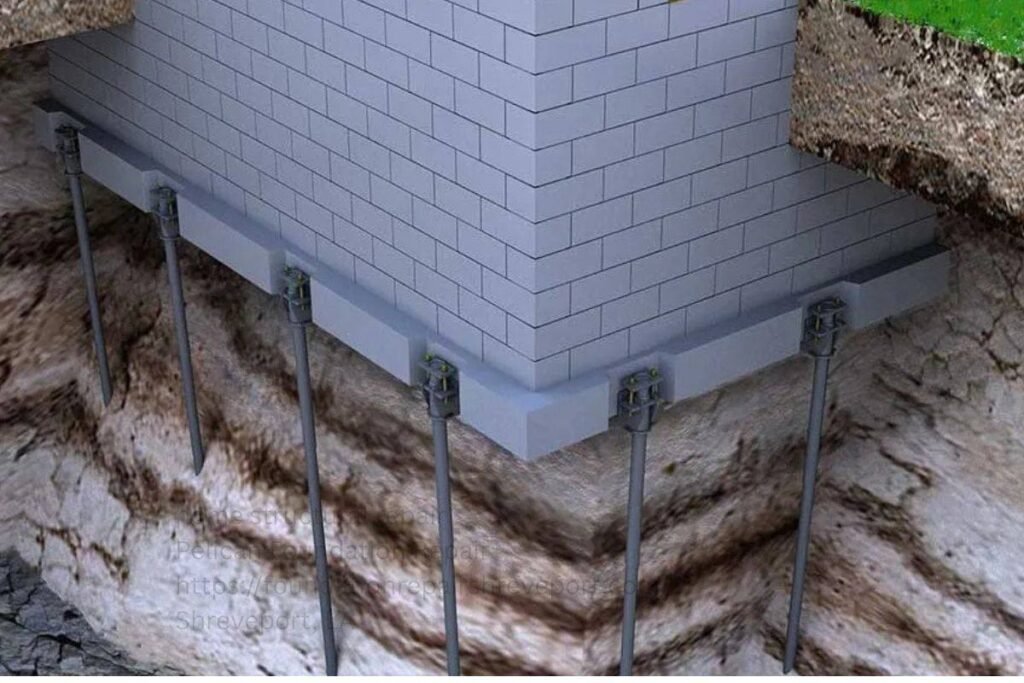
A helical pier looks like a giant screw made of steel. It has one or more round plates — the helices — welded along a central shaft, and it gets twisted down into the ground with hydraulic equipment until it reaches soil dense enough to hold your house. Once it hits that load-bearing layer, a steel bracket connects the top of the pier to your foundation footing, and the weight of the structure is transferred off the soft surface soil and onto the pier.
The reason helical piers exist is the soil under Shreveport. Much of Caddo Parish sits on expansive clay that swells when it rains and shrinks during a dry summer. That constant movement is what causes foundations to settle and crack. A helical pier bypasses the unstable top layer entirely — sometimes going ten, twenty, or even thirty feet down — and anchors into the stable strata below. If you want the plain-English version of how this kind of underpinning works, our guide on what foundation underpinning is walks through the concept step by step.
Why Shreveport Homes End Up Needing Piers
Northwest Louisiana has a particular combination that is rough on foundations: heavy clay soils, big swings between wet springs and dry summers, and mature trees whose roots pull moisture out of the ground around older homes. Neighborhoods like Highland, South Highlands, Broadmoor, and Southern Hills have thousands of homes built in the 1950s through the 1980s on soils that have been moving for decades. In some parts of Bossier Parish, sandy pockets mixed into the clay make settlement even less predictable.
When the soil under one side of a house shrinks more than the other, the foundation drops unevenly. Doors stick, cracks zigzag up brick walls, and floors develop a noticeable slope. Piers fix this by giving the foundation a new, deeper set of feet to stand on. Helical piers are one of two main pier systems used here — the other is steel push piers, which we will compare in a moment.
The Average Cost of Helical Pier Installation in Shreveport
Let us talk real numbers. In the Shreveport metro area, a helical pier installed by a reputable contractor typically costs between $2,500 and $3,500 per pier. That per-pier price includes the pier sections, the helix plates, the foundation bracket, the excavation, the hydraulic installation, the lift (if a lift is part of the plan), and the backfill and cleanup. It does not usually include extras like interior floor work, plumbing repairs discovered during the job, or drainage correction.
Most residential projects need between four and twelve piers. That puts the typical full-project range at roughly $8,000 to $25,000+. Here is how that breaks down by project size:
| Project size | Typical pier count | Estimated cost range |
|---|---|---|
| Single corner or small section | 2–4 piers | $5,000–$14,000 |
| One full side of the house | 4–6 piers | $10,000–$21,000 |
| Half the perimeter | 6–8 piers | $15,000–$28,000 |
| Full perimeter | 8–12+ piers | $20,000–$40,000+ |
| Interior piers (slab homes) | 2–6 piers | $6,000–$21,000+ |
These are ranges, not quotes. Two houses on the same street can need very different pier counts, because one might have settled two inches across one wall while the other has differential settlement around three sides. Interior piers cost more per pier because the crew has to open the slab floor, work inside the home, and restore the concrete afterward. If you are pricing other repair methods too, a general foundation repair cost guide for Shreveport puts piers in context with crack repair, leveling, and drainage work.
Call (318) 585-2003 – Free Inspection
What Makes the Price Go Up or Down
The per-pier number is only half the story. Several factors push a project toward the low or high end of the range, and most of them are specific to your property.
- Depth to bearing soil. This is the big one. If stable soil sits twelve feet down, installation is quick. If the crew has to screw piers twenty-five or thirty feet deep before they hit torque, every pier takes longer and needs more steel. Depth varies across the metro area, and there is no way to know without the installation itself.
- Number of piers. Simple math: more piers, higher total. But there is a small economy of scale — mobilizing equipment and crew costs roughly the same whether you need four piers or eight, so the per-pier price often drops slightly on larger jobs.
- Interior vs. exterior access. Exterior piers are dug by hand from outside. Interior piers require cutting the slab, working inside your home, and patching concrete. Expect interior piers to add $500–$1,500 per pier over exterior work.
- Soil conditions at the surface. Saturated Louisiana clay after a wet spring is miserable digging. Rocky fill, old construction debris, or buried obstacles around older Shreveport homes can slow excavation and add labor cost.
- Obstructions and access. Tight side yards, fences that cannot come down, decks, concrete patios, and mature landscaping near the foundation all make the job slower. A pre-job walkthrough should flag these.
- The lift itself. Some projects stabilize without lifting — the piers stop further settlement and the house stays where it is. If your plan includes raising the foundation back toward level, that is skilled, careful work that adds to the cost.
- Engineering and permits. Most residential pier jobs in our area do not require engineered drawings, but some situations — commercial buildings, retaining walls, or unusual structural conditions — do. Engineering adds cost before work begins.
- Warranty terms. A contractor offering a long structural warranty on the work has to price that risk in. A suspiciously cheap bid often means a short or vague warranty. We cover qualifying repairs with a 20-year structural warranty, and it is worth asking any contractor exactly what theirs covers.
One more cost factor people forget: what the crew finds underground. On slab homes, old drain lines under a settled foundation are often already stressed or broken. If a camera inspection finds damage, the plumbing repair has to happen alongside the pier work. A good contractor tells you this is a possibility during the inspection, not as a surprise on day two.
Helical Piers vs. Steel Push Piers: A Cost Comparison
Helical piers have a close cousin: steel push piers. Both transfer your home’s weight to deep, stable soil. The difference is how they get there. Helical piers screw in with rotational torque; push piers are hydraulically driven straight down, using the weight of the house itself as resistance. In Shreveport, both are common, and the right choice depends on your soil, your foundation type, and your budget.
On price, steel push piers generally cost a little less per pier — often in the $2,000–$3,000 range installed, compared to $2,500–$3,500 for helical piers. The gap exists because helical piers require more specialized equipment and the installation itself is slower. On a ten-pier job, the difference can be several thousand dollars. But cheaper is not automatically better. Push piers need the structure’s weight to drive against, which makes them a poor fit for very light structures like porches or small additions — situations where helical piers work well because the equipment provides the driving force.
There are also situations where helical piers are the clear technical winner regardless of price: new construction (they can be installed before the house is built), very soft surface soils where a push pier cannot get enough resistance to start, and projects where the engineer wants a verified torque reading on every pier as proof of capacity. Our side-by-side breakdown of push piers vs. helical piers goes deeper on which system fits which situation, and our steel push pier installation page covers the alternative system in detail.
A quick word on helical pier downsides
No repair method is perfect, and an honest contractor will tell you where helical piers fall short. They cost more than push piers, the installation equipment is larger and needs more access room, and in extremely dense or rocky soils the helices can struggle to advance. We have also covered helical pier disadvantages in a separate article so you can weigh the trade-offs with clear eyes before you sign anything.
Call (318) 585-2003 – Free Inspection
What Installation Day Looks Like
Knowing the process helps you understand what you are paying for. Helical pier installation is methodical, skilled work — not a quick patch. Here is how a typical exterior job unfolds.
Step 1: Layout and excavation
The crew marks each pier location — usually spaced six to eight feet apart along the settled sections — and hand-digs down to the footing at each spot. On a full job, this is most of day one. The pits are kept tight to protect your landscaping as much as possible.
Step 2: Driving the piers
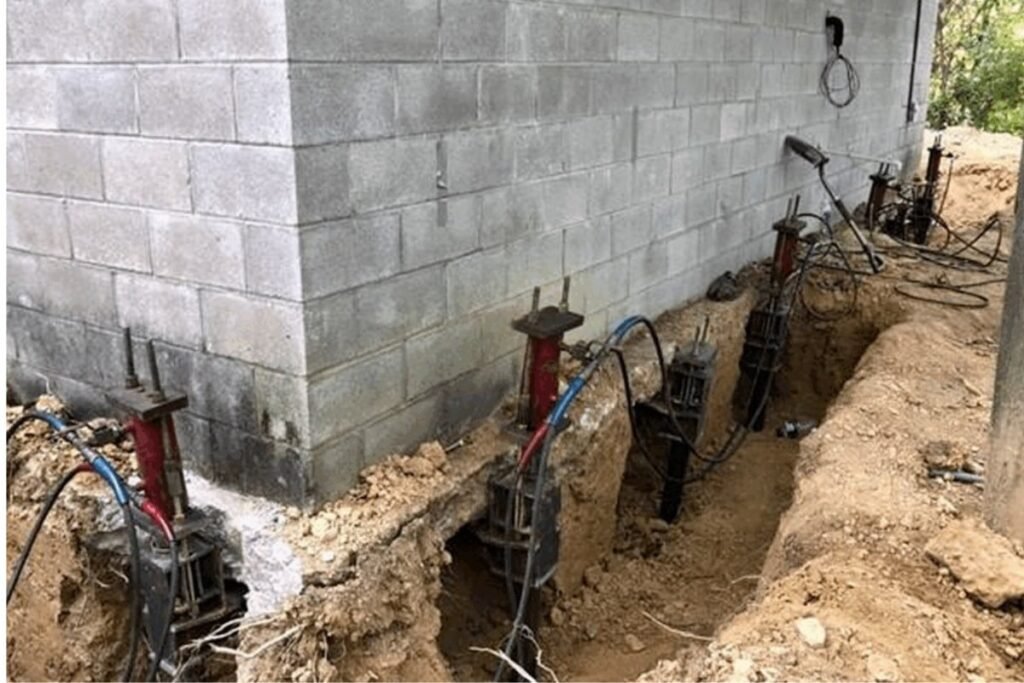
A hydraulic drive head attaches to the first pier section and starts turning it into the ground. The operator watches the torque gauge the entire time. When the target torque is reached, that means the helix has bitten into soil dense enough to carry the load. If it has not, another section is coupled on and the pier goes deeper. This continues until every pier hits verified bearing. This is the most technical part of the job, and it cannot be rushed.
Step 3: Bracket attachment and lift
Steel brackets are fitted to the footing and connected to the pier tops. If the plan calls for a lift, hydraulic jacks raise the foundation slowly and evenly while the crew monitors elevation readings, door function, and existing cracks. Most residential lifts happen in a single day.
Step 4: Lock-off, backfill, and cleanup
Final elevations are locked in, the excavations are backfilled and compacted in layers, and the crew cleans the site. You get final elevation readings documenting where the foundation sits now versus where it started. Most exterior jobs finish in one to three days; interior work adds time.
One thing worth knowing: you can stay in the house during all of this. Exterior pier work happens entirely outside, and even the lift — the noisiest day — is a single-day event. The InterNACHI standards at nachi.org describe what a proper structural evaluation looks like before work like this begins.
When Helical Piers Are the Right Call (and When They Are Not)
Helical piers are the right tool in specific situations. They shine on lighter structures — porches, room additions, stoops, and decks — where push piers cannot get enough driving resistance. They are the go-to choice for new construction, where they can be installed before the foundation is poured. They work well in very soft or saturated surface soils, and in projects where an engineer wants a torque reading on every single pier as documentation of load capacity.
They are a strong choice for standard residential settlement too, especially when access is decent and the homeowner values the verified-torque documentation. In neighborhoods around Cross Lake and along the Red River, where soil profiles can change quickly from one lot to the next, that verification gives real peace of mind.
When might they not be the best fit? If your home is a heavy two-story brick structure on a slab and the soil allows it, steel push piers often deliver the same result for less money. If access is extremely tight — the helical drive equipment needs more room than push pier equipment — that can rule them out for some side yards. And if the bearing layer is exceptionally deep, the extra steel sections narrow the cost gap in a way that deserves an honest conversation with your contractor.
The bottom line: the “best” pier is the one matched to your soil, your structure, and your budget — not the one with the most impressive brochure. A contractor who only sells one pier system will always recommend that system. Look for one who installs both and can explain why they are recommending a particular one for your house.
Call (318) 585-2003 – Free Inspection
How to Get an Honest Quote
Pier quotes vary more than almost any other home repair, because the work is so site-specific. Here is how to make sure the number you get is real.
- Insist on elevation readings. A real quote starts with a floor elevation survey — dozens of readings mapped across the house showing exactly where and how much the foundation has dropped. Anyone quoting piers without this is guessing.
- Get the pier count and layout in writing. The quote should show where each pier goes and why. Vague quotes like “piers as needed” are a red flag.
- Ask what is excluded. Interior floor restoration, plumbing repairs, drainage work, and landscaping restoration are common exclusions. Knowing them upfront beats discovering them mid-job.
- Compare warranties, not just prices. A 20-year structural warranty on qualifying repairs means the contractor stands behind the work for decades. Ask exactly what triggers a warranty claim and what the process looks like.
- Get at least two quotes. For a $15,000–$30,000 project, a second opinion is worth the hour it takes. If two reputable contractors recommend similar pier counts and layouts, you can be confident in the plan.
- Ask about the soil. A contractor who can talk specifically about Caddo Parish clay, bearing depths in your neighborhood, and how local soil behaves in drought has done this work here. Generic answers suggest otherwise.
Be wary of quotes that are dramatically lower than the rest — they usually mean fewer piers than the house needs, thinner steel, or a warranty that is not worth the paper it is on. And be wary of high-pressure tactics: “this price is only good today” has no place in a decision this size. A solid guide to choosing a foundation repair contractor in Shreveport covers the questions that separate the pros from the pretenders.
The LSU AgCenter publishes research on lsuagcenter.com about how Louisiana’s expansive soils behave — useful background if you want to understand what is happening under your home before the contractor arrives.
Frequently Asked Questions
How much does one helical pier cost installed?
In the Shreveport area, a single installed helical pier typically costs between $2,500 and $3,500. That price includes the pier, the foundation bracket, excavation, installation, and backfill. Interior piers cost more because the crew has to open and restore the slab floor.
How many helical piers does a house usually need?
Most residential jobs need between four and twelve piers, spaced six to eight feet apart along the settled sections. A single settled corner might need only two or three, while a full perimeter stabilization can need twelve or more. An elevation survey during the inspection determines the exact count.
Are helical piers better than steel push piers?
Neither is universally better. Helical piers work well on lighter structures and in soft soils, and every pier gets a verified torque reading. Steel push piers usually cost less per pier and suit heavy structures well. A contractor who installs both systems can recommend the right one for your soil and house.
How long do helical piers last?
Helical piers are made of galvanized steel and anchored in stable, deep soil below the active clay layer, so they are designed to last for decades. Reputable contractors back qualifying pier installations with long structural warranties — ours carries a 20-year structural warranty on qualifying repairs.
Can helical piers be installed in any soil?
They work in most soil types found in northwest Louisiana, including the expansive clays around Shreveport and the mixed soils in parts of Bossier Parish. Extremely dense or rocky layers can slow installation, but the torque gauge tells the crew exactly what the soil is doing on every pier.
Will helical piers lift my house back to level?
They can, if a lift is part of the plan. Some projects stabilize only — the piers stop further settlement and the house stays at its current elevation. Others include a controlled lift back toward level. Your contractor should explain which approach your home needs and what result to expect.
How long does helical pier installation take?
Most exterior residential jobs finish in one to three days: excavation, pier driving, the lift, then backfill and cleanup. Interior piers and larger pier counts add time. You can stay in the home during the work.
Call (318) 585-2003 – Free Inspection
Get a Free Helical Pier Inspection in Shreveport
The only honest price for helical piers is one based on your home’s actual settlement, measured with elevation readings — not a guess over the phone. Our free inspection gives you a settlement map, a pier layout, and a written quote with no obligation.
Call Pelican Foundation Repair at (318) 585-2003, or visit Pelican Foundation Repair to schedule. We serve Shreveport and the surrounding areas — see our full service area list — and you can browse all of our foundation repair services to compare pier systems, crack repair, and drainage options.
Pelican Foundation Repair 6118 Fairfield Ave, Shreveport, LA 71106, USA 318-585-2003 https://foundationrepairshreveport.com/