Skip to main content

How Long Does Helical Pier Installation Take?
Most helical pier installations in Shreveport take 1 to 3 days. This guide breaks down timelines by job size, the installation steps, and what can add a day.
How long does it take to install helical piers? For most Shreveport homes, the answer is 1 to 3 days of on-site work. A small job of 6 to 10 piers often finishes in a single day, while a full perimeter stabilization of 20 to 30 piers usually takes 2 to 3 days. The free inspection beforehand takes about an hour or two.
Helical piers are fast because the crew never waits on anything: no concrete to cure, no weather window for pouring. Each pier gets screwed into the ground until it hits load-bearing soil, a bracket ties it to your foundation, and the crew moves on. Your timeline mostly comes down to pier count and soil depth.
Helical Pier Timelines by Job Size
Pier count drives the schedule more than anything else. Here is what typical Shreveport jobs look like:
| Job Size | Typical Timeline | Common Scenario |
|---|---|---|
| 6–10 piers | 1 day | One settling corner or a single failing wall section |
| 11–18 piers | 1–2 days | Half the perimeter or two adjacent sides of the house |
| 19–30 piers | 2–3 days | Full perimeter stabilization on an average home |
| 30+ piers | 3–5 days | Large homes, additions, or deep unstable soil requiring extra piers |
Helical piers are load-tested as they are installed: torque readings tell the crew the pier has reached soil strong enough to hold the house, so there is no waiting period. The moment the lift is done, the foundation is supported — no curing days like concrete-based methods.
As with any foundation work, the inspection and scheduling come first and sit outside these numbers. Expect 1 to 2 hours for the inspection and 1 to 3 weeks of scheduling lead time in Shreveport, longer in spring. For cost context alongside these timelines, see our guide to helical pier installation cost.
How Helical Pier Installation Works, Step by Step
Knowing the sequence helps you understand where the time goes — and why there is so little waiting involved. Here is a typical install day:
1. Excavation at each pier point
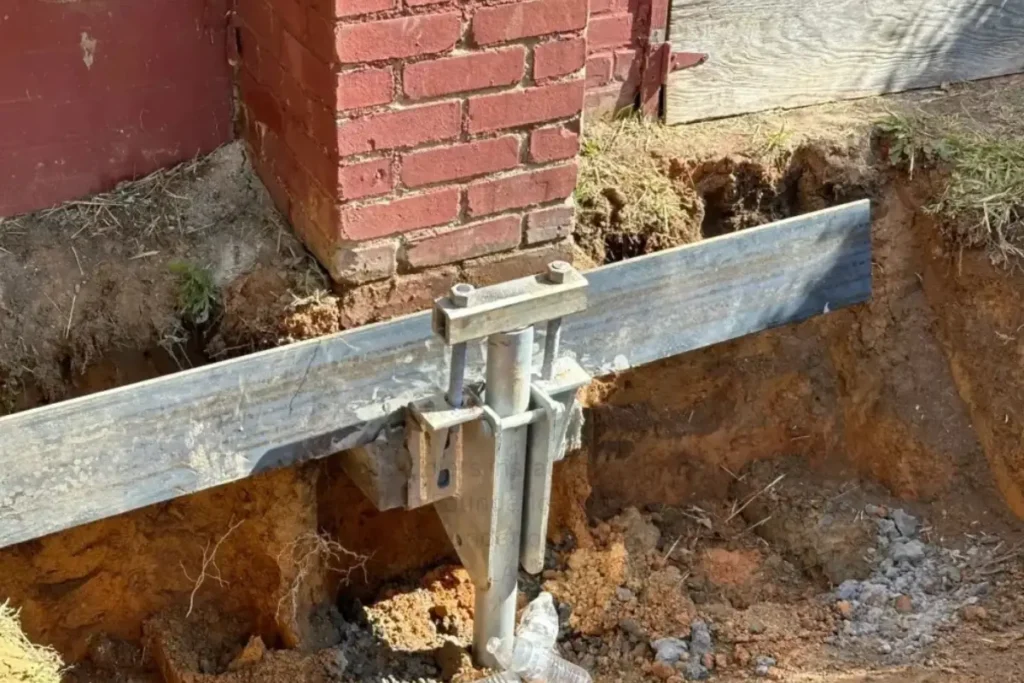
The crew digs a small pit — usually about 3 feet square — at each pier location along the foundation, exposing the footing. On a 20-pier job, this is the morning’s work for part of the crew while the equipment gets staged. Small pits mean small mess: your landscaping takes a hit only in narrow strips along the foundation.
2. Driving the piers
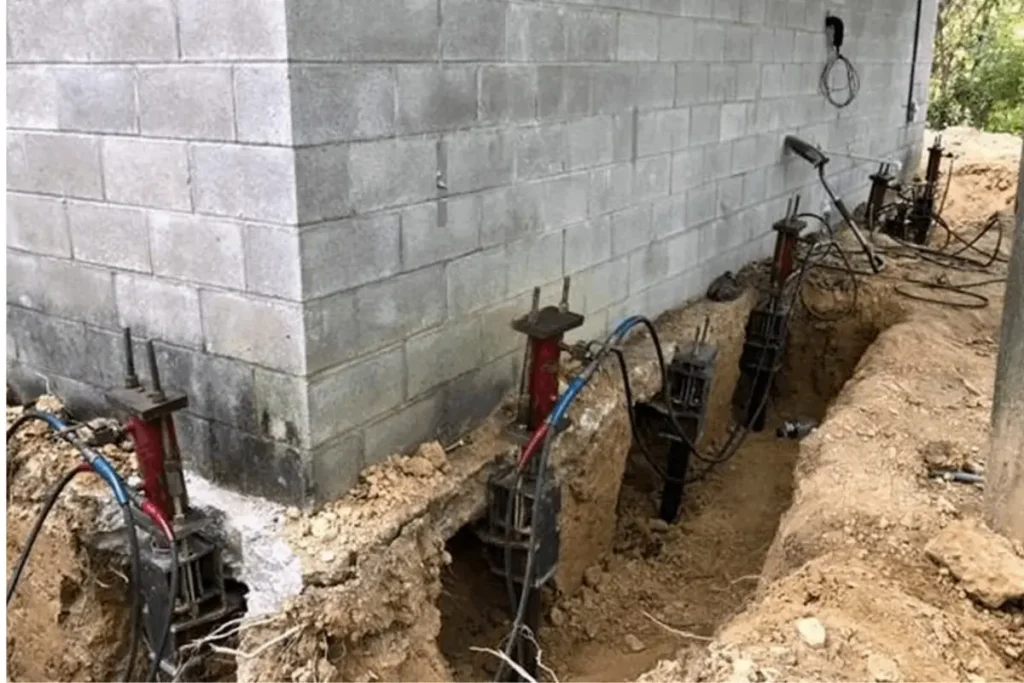
A helical pier looks like a giant screw, and it goes in like one. The hydraulic drive head rotates each pier into the ground, adding extension sections as needed, until torque readings confirm it has reached load-bearing soil. This is the heart of the job and where most of the day goes. In Shreveport clay, depths vary — our guide to how deep helical piers go explains what local crews typically encounter.
3. Brackets and the lift
A steel bracket gets fitted to each pier and attached under the footing. Then, slowly and evenly, the crew lifts the settled sections back toward level — fractions of an inch at a time, monitored across the whole foundation. The lift itself usually takes a few hours on the final day. It is the most dramatic part to watch and the most carefully controlled.
4. Backfill and cleanup
Pits get backfilled, soil gets tamped, and the crew cleans up daily. By the time the last pier is in, the first pits are already filled. There is no curing, no waiting, no return trip — the job ends when the cleanup ends.
What Can Make a Helical Pier Job Take Longer
Most helical jobs finish inside the table ranges. When one stretches, it is usually one of these:
- Deep stable soil: the crew drives each pier until torque confirms load-bearing soil. In parts of Shreveport where that layer sits deeper — old fill areas, low ground near bayous — every pier takes more sections and more time.
- Tight access: the drive equipment needs room to work along the foundation. Fences, AC condensers, decks, and dense landscaping slow the crew as they work around or temporarily move obstacles.
- Interior piers: piers needed under the middle of the house (not just the perimeter) mean cutting through the slab inside, which adds a day of interior work, dust control, and concrete patching.
- Underground utilities: gas, water, and electric lines near the foundation must be located and worked around. Most of the time this is just careful planning; occasionally it reroutes a pier or two.
- Heavy rain: open pits and saturated clay do not mix. A multi-day soaker from a tropical system can pause excavation until the ground firms up.
- Extra piers discovered mid-job: sometimes the lift reveals an adjacent section that needs support too. A good crew flags it, shows you why, and gets approval before adding piers — each one adds under an hour, but several add up.
The common thread: depth and access. Everything else about helical installation is fast by design, so the variables that matter are how far down the crew must go and how easily they can get the equipment where it needs to be.
Helical Piers vs. Steel Push Piers: Timeline Differences
Homeowners often ask how helical piers compare with steel push piers on speed, since both are common in Shreveport. The honest answer: the timelines are close. Both install at roughly the same pace — a crew does 10 to 20 piers a day with either system, and neither requires curing time. The choice between them usually comes down to soil conditions and foundation type, not speed.
The practical differences show up at the edges. Helical piers give the crew a torque reading during installation — a live measurement of soil capacity — which can reduce guesswork in variable soil. Steel push piers rely on the structure’s own weight for resistance during driving, which works well on heavier structures. For most residential jobs in northwest Louisiana, either system lands in the same 1-to-3-day window. Pelican’s steel push and helical pier installation crews work with both systems and recommend based on your soil and foundation, not on what is fastest to sell.
What Installation Day Feels Like for Homeowners
You can stay home — nearly everyone does. The work is outside, along the foundation, and inside the house you will mostly hear it: the hydraulic drive unit has a distinctive low churn, and there is periodic clanking as sections get added. It is daytime construction noise, not house-shaking. If you work from home, it is noticeable but manageable; most people just close the office door.
A few things that help the days go smoothly: move cars out of the driveway so equipment and pier sections can be staged, keep pets inside and away from open pits, and let the crew know about sprinkler heads, buried dog fences, or septic lines near the foundation. Crews backfill and tamp as they go, and they clean up each evening — lumber, packaging, and equipment staged neatly, pits filled. Your yard will show narrow disturbed strips along the foundation for a while, but sod and landscaping recover, and many homeowners re-sod the strips the following season.
One thing you will not deal with: a return trip for curing or settling-in. Because each pier is load-tested during installation, the foundation is supported the day the crew leaves. Follow-up is just the warranty paperwork and, if you want it, a re-check of elevations down the road.
Shreveport Soil and Helical Pier Timelines
The USDA’s Web Soil Survey maps much of Caddo and Bossier parishes as expansive clay, and that soil shapes helical pier work in two ways. First, the active clay layer — the zone that swells and shrinks with the seasons — is exactly what the piers must get below. In Shreveport that means driving past the moisture-cycling zone to stable, load-bearing soil, which is why local pier depths run deeper than the national brochures suggest. Deeper drives mean more sections per pier and slightly longer days.
Second, wet conditions slow excavation. After a wet spring or a tropical-system soaking, the clay along the foundation turns to heavy muck, and digging clean pits takes longer. Crews in the 71106, 71105, 71118, and 71107 ZIPs know to check ground conditions before promising a one-day turnaround on a big job — and an honest timeline accounts for it. The Deep Foundations Institute (DFI) publishes the industry standards these installations follow, and local experience fills in the Shreveport-specific details.
Start with a free inspection from Pelican Foundation Repair — Monday through Saturday, 8:00 AM to 6:00 PM — and you will get elevation readings, a pier plan with an honest day count for your house, and a written quote. No phone guesses, no pressure.
Frequently Asked Questions
How long does it take to install helical piers?
Most residential jobs take 1 to 3 days: 6 to 10 piers in a day, 11 to 18 piers in 1 to 2 days, and full perimeter jobs of 19 to 30 piers in 2 to 3 days. Larger jobs can run 3 to 5 days.
Can helical piers be installed in one day?
Yes, for smaller jobs. At 10 to 20 piers per day, a single settling corner or one wall section of 6 to 10 piers typically finishes in a day, backfill and cleanup included.
Do I need to move out during helical pier installation?
No. All work happens outside along the foundation. You will hear the hydraulic equipment during the day, but utilities stay on and nothing inside the house is disturbed.
Is there any curing or waiting time after helical piers are installed?
No. Each pier is load-tested during installation via torque readings, so the foundation is fully supported the day the crew finishes. There is no curing period and no return trip.
What slows down a helical pier installation?
Deep stable soil requiring more pier sections, tight equipment access, interior piers needing slab cuts, underground utilities, and heavy rain turning excavation pits to muck.
Are helical piers faster than steel push piers?
Roughly the same. Both install at 10 to 20 piers per day with no curing time. The choice between them comes down to soil conditions and foundation type, not speed.
How soon can the work start after the inspection?
Typically 1 to 3 weeks out in Shreveport, depending on crew scheduling. Spring runs busiest because wet weather drives foundation calls across northwest Louisiana.
Pelican Foundation Repair
6118 Fairfield Ave, Shreveport, LA 71106, USA
318-585-2003
https://foundationrepairshreveport.com/