 Skip to main content

Push Pier Load Tests: How Contractors Prove the Piers Hold
How contractors prove each steel push pier actually holds: what a load test measures, what refusal means in Shreveport clay, and what happens when a pier must go deeper.
What is a push pier load test? It is measured verification that each steel push pier is driven until the ground pushes back hard enough to carry your home. The crew watches hydraulic gauges as every pier goes in; when a pier stops advancing under the required force — called refusal — it has reached load-bearing soil. Proven, not assumed.
That short answer covers the whole idea, and it matters more than most homeowners realize. A pier that looks installed is not the same as a pier that is proven. Plenty of foundation work fails years later because piers were driven to a guessed depth — never truly bearing in soft soil — and the house kept sinking. In northwest Louisiana, stable soil depth can change from one corner of a house to the other, so that measurement is everything.
Below: what the gauges measure, what refusal really means in our Red River valley clay, how driving resistance differs from a separate proof test, and what an honest contractor does when a pier has to go deeper than expected.
What a Push Pier Load Test Actually Is
A “push pier load test” is not a lab experiment or a separate appointment. For steel push piers, the load test is the installation — the two happen together, pier by pier, in real time.
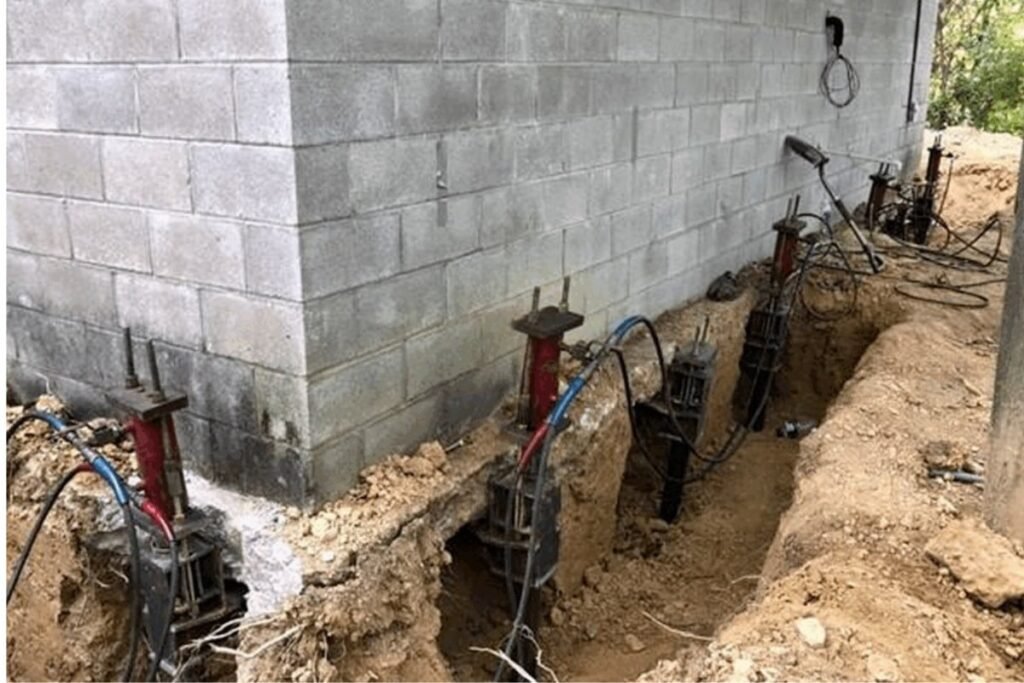
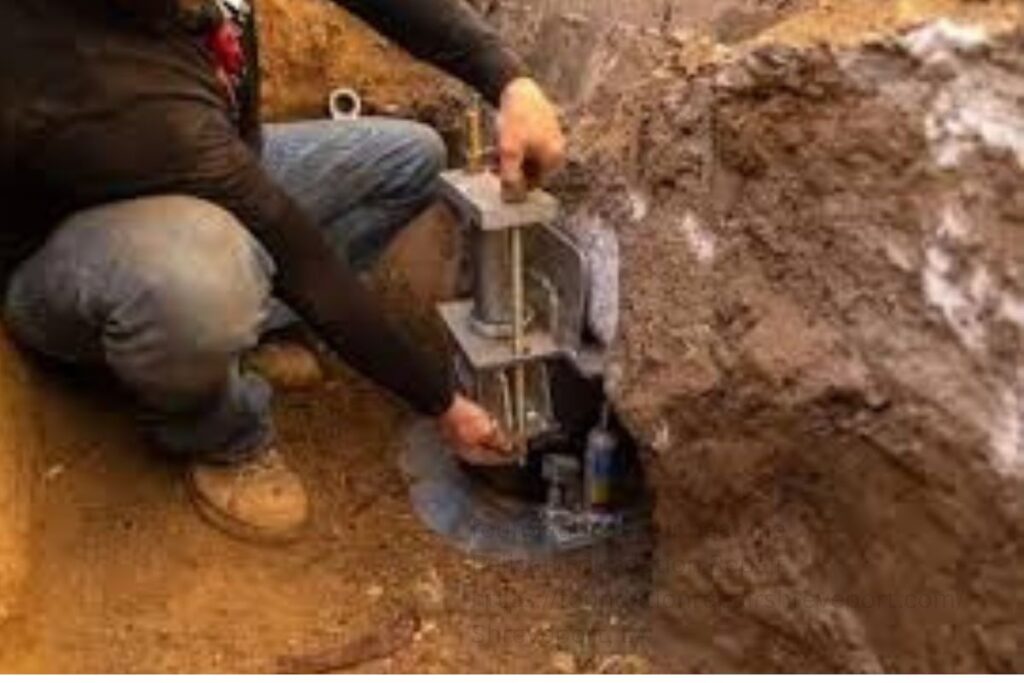
Here is the idea in plain terms. A steel push pier is a series of steel tube sections. The crew attaches the first section to a bracket under your foundation, then a hydraulic cylinder pushes it straight down — using the weight of your house as the reaction force.
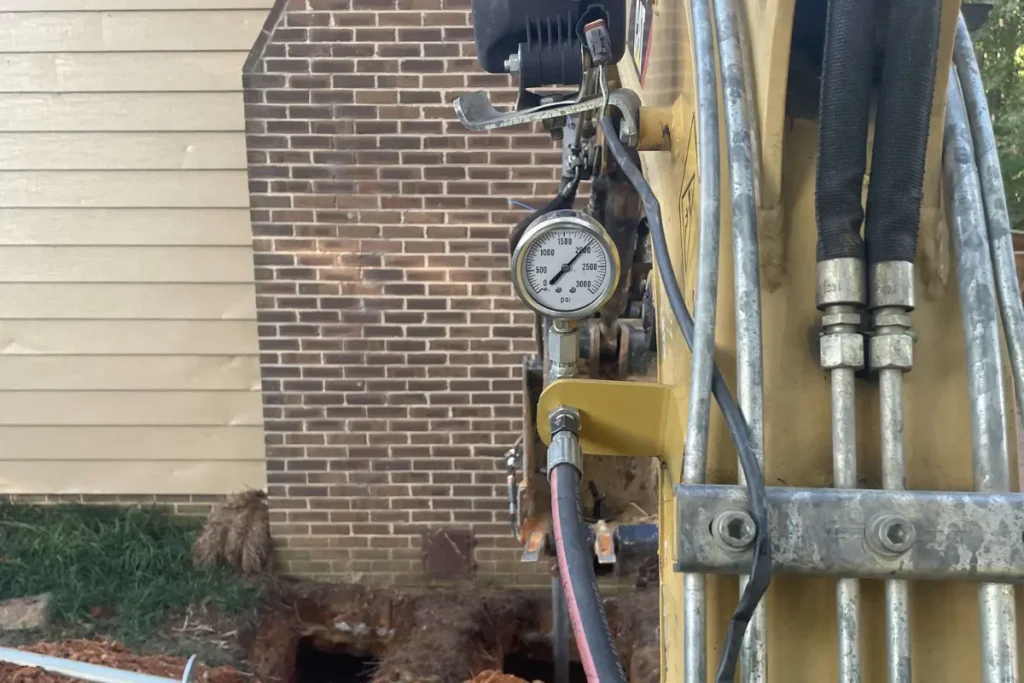
As the pier goes down, the crew watches hydraulic pressure gauges: low readings in soft soil, climbing resistance as it reaches firm, load-bearing ground.
That climbing number is the whole game. Before the job, the contractor sets the target: each pier must be driven until driving resistance meets or exceeds the design load for that point — the weight that pier will carry once the house is lifted onto it. When the pier stops advancing under that force, it has reached refusal.
What “Refusal” Really Means — and What It Does Not
Refusal sounds like the pier hit something hard — but it is not hitting bedrock. In northwest Louisiana there is no bedrock anywhere near residential depths, so a contractor who says a pier “hit rock” under a Shreveport home is telling you a story.
Refusal means the pier has reached soil dense and stable enough to carry the structure — load-bearing strata. Under Shreveport, that means getting past the restless upper layers into firmer material below. Our ground is Red River alluvial soil — clay, silt, and sand laid down over thousands of years. The top layers form the active zone: shrink-swell clay that moves with every wet and dry spell. Deeper layers barely move. Refusal is reaching that quiet ground.
Here is what refusal does not mean:
- It is not a fixed depth — no magic number. The bearing layer can sit shallower under one side of your house and deeper under the other; refusal is a measured condition, not a depth on a chart.
- It is not “the pier can’t go any further.” With enough force, steel keeps going. Refusal is where resistance equals or exceeds the load the pier must carry — a design decision, not the equipment’s limit. Stopping early saves steel but leaves the pier in soft ground.
- It is not the same at every pier. Soil is not uniform: one pier might find bearing quickly while the next, twenty feet away, needs more sections. That is normal in our valley soils — and exactly why each pier is tested on its own.
The honest version: refusal is a judgment call backed by a number — the gauge’s resistance against the design’s required load. When the first meets or beats the second, the pier is done. If a contractor cannot explain that — or does not measure at all — keep looking.
Why Every Pier Gets Tested — Especially in Northwest Louisiana Clay
Some companies test a few piers and assume the rest — a shortcut that fails here, because the ground under your house is not the same from one corner to the other.
The Shreveport-Bossier area sits in the Red River valley, and the soil is a patchwork. Old river channels, filled low spots, and soft lenses hide in the clay where you cannot see them. The NRCS Web Soil Survey — a free federal tool — shows how much mapped soils vary across a single neighborhood. A home in South Highlands can have very different bearing depths than one near the river in 71106, and both can differ pier to pier.
Then there is the weather, which is stressing the upper soil right now. This fall has been severely dry across northwest Louisiana — weeks of shrinking clay, which is when settlement shows itself. Rain returns over Halloween weekend, October 30–31, ahead of a wetter-than-average winter: the hardest dry-to-wet cycle of the year.
That active upper layer is exactly what piers must get past. A pier that stops in the shrink-swell zone — close enough to look finished — will keep moving with the seasons, and the house with it. Testing every pier to its own refusal is the only way to be sure each one reached the quiet ground below.
Driving Resistance vs. a Separate Proof Test: Two Different Checks
Homeowners sometimes hear two different terms and wonder if they are getting both, one, or neither. They are related but not the same:
| Check | What it is | When it happens |
|---|---|---|
| Driving resistance | Continuous gauge readings as each pier is driven; refusal verified per pier | During installation, on every pier |
| Proof load test | A defined load applied and held while movement is measured on selected piers | Engineer-specified; common on commercial or complex jobs |
| What it proves | Driving resistance proves each installed pier reached bearing; a proof test validates the system’s design assumptions | Both answer “will it hold?” — at different scales |
For a typical Shreveport home, continuous driving resistance is the load test — it verifies every pier during installation. A separate proof test applies a predetermined load to selected piers (sometimes a sacrificial test pier) and measures movement over a hold period. Engineers specify it for commercial buildings or unusual soils where the design itself needs validating.
Here is the trick to watch for. Steel push piers verify themselves as they are installed — the gauge never stops watching. Helical piers are verified through installation torque — the twisting force used to screw them in, which correlates with soil capacity — same prove-as-you-go principle, different measurement. (Our push piers vs. helical piers comparison covers when each fits.) Any method driven blind — no gauges, no torque readings — is one where “tested” is just a word in the brochure.
What Happens When a Pier Never Reaches Refusal
Here is the honest part no brochure leads with: sometimes a pier keeps going. Section after section goes in, the gauge stays low, and the stable layer is deeper than anyone guessed. Soft lenses, old fill, buried creek beds — northwest Louisiana soil is full of surprises, especially on filled lots in Bossier City, Keithville, and Greenwood.
A good contractor has exactly one response: keep driving. More sections get coupled on, the pier goes deeper, and it does not stop until the gauge proves bearing. That is what the test is for — stopping at a convenient depth is how you get a pier that looks finished and behaves like it is not there.
Now the part you are wondering about: cost. Deeper piers use more steel. Good companies state the rule in writing before the first section goes in: the pier stops when the gauge says bearing, with clear per-section pricing beyond the quoted depth. A quote that cannot say what happens when a pier runs deep is missing the whole job.
The rare pier that never reaches adequate resistance gets a plan change: relocating the pier point, adjusting spacing, or switching methods for that section. That is not failure; it is the test doing its job. Better to learn it during installation than five years later as a warranty claim. Our steel push pier installation cost guide covers how depth and pier count shape the price.
How to Read Your Own Job: Questions Worth Asking
You do not need an engineering degree — just five minutes of straight talk with the crew leader. These questions separate measured work from guesswork:
- “How do you verify refusal on each pier?” Listen for gauges, pressure readings, and a design load — not “we go deep enough” or “we have been doing this for years.”
- “Can you show me the readings as you work?” The gauges sit right at the drive stand, and a crew that measures is glad to show you. One that does not want you looking is telling you something.
- “What is the target load for my piers?” The proposal should show pier placement and counts — our guide to how many piers a house needs explains how that count is figured — and the refusal target follows.
- “What happens if a pier runs deeper than expected?” The answer should be a written rule, agreed before work starts: the pier goes until the gauge proves bearing, with clear pricing for extra sections.
- “Do I get the readings in my paperwork?” Per-pier documentation — locations, depths, refusal readings — is what makes the warranty meaningful and the job sellable at resale.
- “What voids the warranty?” Fair question on any structural job. You want the terms on paper: length, coverage, and what you must not do.
None of these is confrontational — they are what any homeowner in Broadmoor, Southern Hills, or Blanchard should ask before steel goes under their house. The contractors worth hiring answer all six without blinking, because on their jobs the gauges are already doing the talking. Start with a free inspection and elevation survey: pier count, depth, and test results all come from real measurements, not estimates. For the bigger picture of what foundation repair covers in Shreveport, that first hour of data is where every good job begins.
Frequently Asked Questions About Push Pier Load Tests
What is a push pier load test in simple terms?
It is the measured proof that each steel pier is holding. As the crew drives a pier, hydraulic gauges show how much force the ground pushes back with. When that resistance meets or beats the load the pier must carry — refusal — the pier is proven, not just installed.
How do I know my piers actually reached refusal?
Ask for the per-pier readings: location, final depth, and driving resistance at refusal, delivered with your warranty paperwork. If the company cannot produce them, the piers were driven to a guess, not a measurement.
Is driving resistance the same thing as a proof test?
Not quite. Driving resistance is the continuous measurement on every pier during a residential install. A separate proof test applies a defined load to selected piers and measures movement over a hold period; engineers specify it for commercial buildings or unusual soils.
What happens if a pier never reaches refusal?
The crew keeps adding sections and driving deeper until the gauge proves bearing. If adequate resistance cannot be reached at a reasonable depth, the plan adjusts: relocating the pier, changing spacing, or switching methods for that section. An honest contractor states this rule in writing before work starts.
Does load testing make the job more expensive?
For steel push piers, testing is built into the installation — the gauges run while the piers go in, so there is no separate testing fee. What changes the price is depth: a pier needing more sections to reach refusal uses more material. That is why per-section pricing for extra depth belongs in your written quote.
Can a push pier fail its test after the house is lifted?
A pier at verified refusal in stable soil should not move. Later problems almost always trace to piers that never truly reached refusal, or to drainage changes that altered the surrounding soil. The per-pier readings are the record that each pier was proven.
Do helical piers get load-tested the same way?
Same principle — prove it as you install it — different measurement. Helical piers are screwed in, so capacity is verified through installation torque: the twisting force needed to advance the pier, which correlates with load capacity. Both are measured, real-time verification.
Pelican Foundation Repair
6118 Fairfield Ave, Shreveport, LA 71106, USA
318-585-2003
https://foundationrepairshreveport.com/