Slab vs Pier and Beam: Which Costs More to Repair?
Slab or pier and beam: which repair hits your wallet harder? We compare real Shreveport costs, what drives each price, and when each type is the cheaper fix.
Usually, a slab repair costs more than a pier and beam repair, because the crew works through solid concrete with limited access. A pier and beam home usually costs less to fix, since the crawl space lets a crew reach the problem. Small slab cracks run , while a big pier job can reach .
If you own a home in Shreveport, Bossier City, or anywhere in Caddo or Bossier Parish, the foundation under your house shapes almost everything about the bill. This post gives you a straight answer, then walks through the cost drivers for each type.
The Short Answer: Which Costs More to Repair?
For the same amount of settlement, a slab repair usually costs more than a pier and beam repair, and the reason is access. A slab crew has to work through a thick concrete pad that carries the whole house. A pier and beam crew can crawl under the house, look straight at the failing pier or beam, and fix it in place.
That does not mean every slab job beats every pier and beam job on price. A hairline crack in a slab can cost far less than a pier and beam home with rotted beams and a dozen failing piers. The type sets the starting point; the house’s condition sets the final number.
Shreveport soil makes the question matter more here. Our expansive clay swells when it soaks up rain and shrinks when it dries out, and that shrink-swell cycle moves foundations year after year. Heavy rain in the spring and long dry spells in the summer both push on a foundation, and the type of foundation decides what that movement costs to correct.
What a Slab Repair Involves and What Drives Its Price
A slab foundation is a single thick concrete pad poured right on the ground, with the house built on top of it. There is no crawl space and no basement. Plumbing lines often run through or under the slab. When the soil under one corner shrinks or washes away, that corner sinks, and the slab cracks or tilts.
Small slab problems are cheap to fix. A hairline crack can be sealed with epoxy injection, and Pelican’s published range for crack repairs is , the lowest-cost repair either foundation type will ever see.
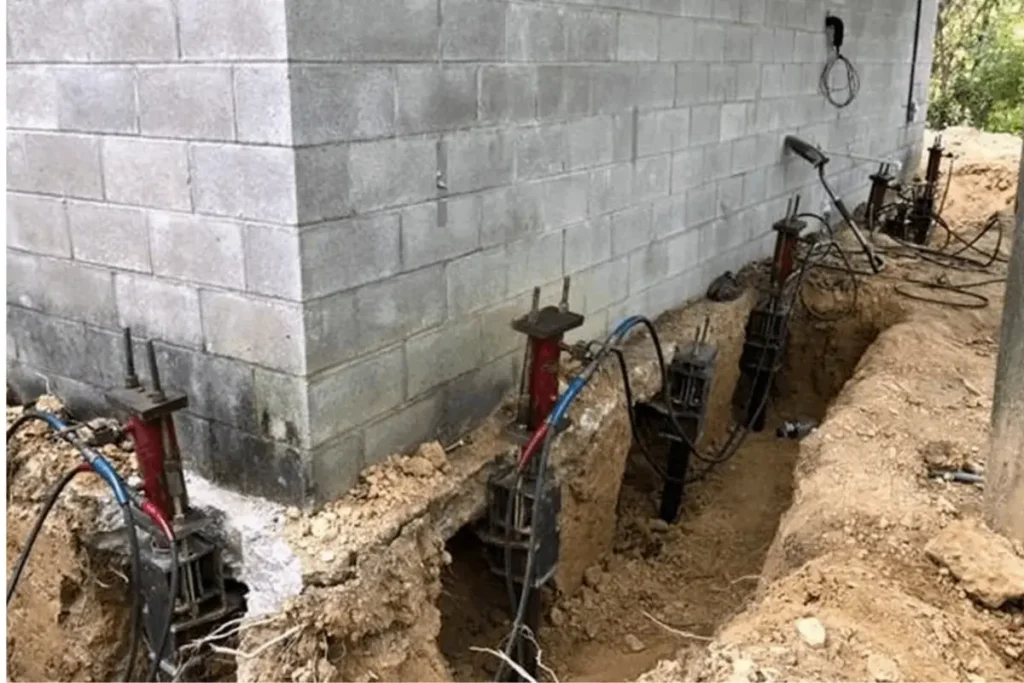
The price climbs fast when the slab has actually settled. Lifting a settled slab means installing steel push piers or helical piers around the sinking section and raising it back toward level, with piers driven down to stable ground below the active clay layer. Pelican’s published range for full pier jobs is to , with typical pier work between depending on pier count.
Pier count is the biggest cost driver on a slab job. A corner that dropped an inch may need only a handful of piers, while a whole side that settled may need a dozen or more, and every extra pier adds labor, steel, and time. Depth matters too: Shreveport clay can run deep, and deeper piers cost more to install. Access adds cost too, because the crew digs or drills from outside the house, often in tight spots by a fence or driveway. Plumbing is the third driver: when a slab settles, buried pipes can bend or crack, and a leak under a slab means cutting into the concrete to find it.
Slab jacking, also called mudjacking or foam lifting, is the cheaper option for a sunken slab section that has not settled deeply. Pelican’s published range for concrete leveling runs , at roughly per square foot. Foam or grout is pumped under the slab to raise it. It works well for a sunken driveway or patio, but it does not stop deep soil movement, so it is not a substitute for piers when the foundation is still settling.
What a Pier and Beam Repair Involves and What Drives Its Price
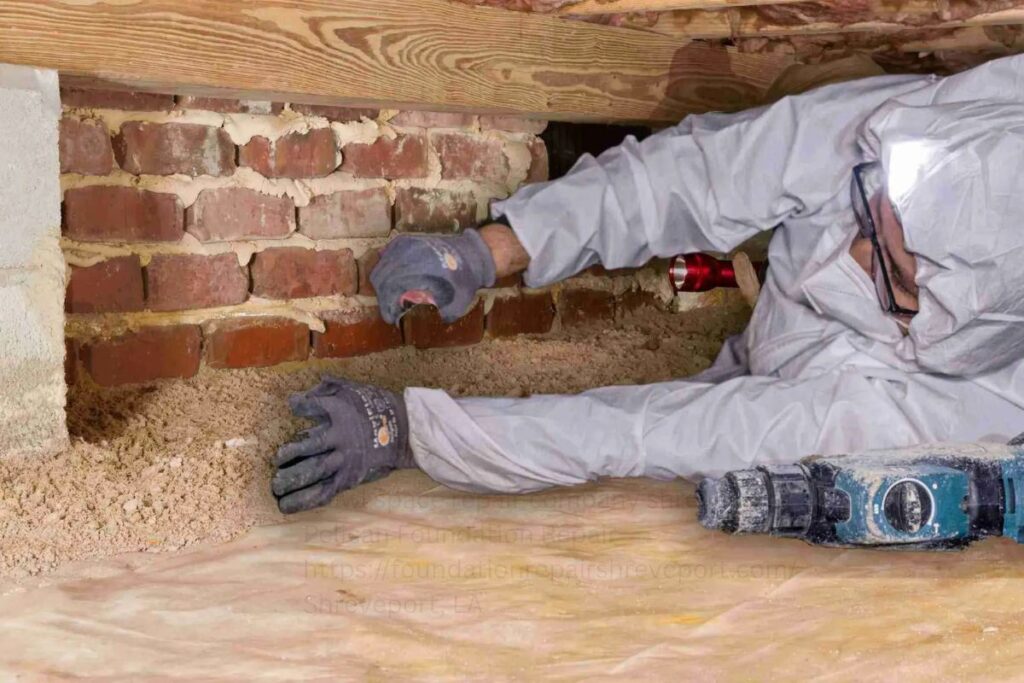
A pier and beam foundation lifts the house a few feet off the ground on concrete or brick piers, with wooden beams and floor joists spanning between them. The crawl space underneath is why pier and beam repairs are usually cheaper: a crew can get under the house and work on the exact part that failed.
Most pier and beam repairs start small. A settled pier can be shimmed, which means slipping steel shims between the pier and beam to level the floor. A sagging beam can be sistered, which means bolting a new beam alongside the old one.
The price climbs when the problem is many piers, not one. A pier and beam home in South Highlands or Broadmoor that has been settling for years may have a dozen piers out of level and several beams with rot. Each pier needs shimming or replacement, and the crew has to lift the house in sequence so the floors come up evenly. Pelican’s published range for full pier jobs runs to , with typical pier work between depending on pier count.
Moisture is the biggest enemy of a pier and beam home in northwest Louisiana. Gulf humidity and heavy rain seasons keep crawl spaces damp, and damp wood rots. A crawl space that stays wet will rot beams and joists, invite termites, and wear out piers faster than a dry one. That is why a pier and beam repair often comes with a second conversation about drainage: fixing the piers without fixing the water means the same repair will be needed again too soon. Plumbing, by contrast, is where pier and beam homes have a clear advantage: pipes run through the crawl space, not through concrete, so a leak can be found and fixed without cutting anything.
Slab vs Pier and Beam Repair Cost, Side by Side
The table below puts the two types next to each other. Pelican ranges are our published prices; industry ranges are national figures from established cost guides, labeled as such, and useful for planning but not a quote.
| Repair or cost factor | Slab foundation | Pier and beam foundation |
|---|---|---|
| Small crack or minor fix | (Pelican published range) | Often lower; shimming one pier is quick |
| Full pier job | (Pelican published range) | (Pelican published range) |
| Typical pier work | by pier count (Pelican published range) | by pier count (Pelican published range) |
| Lifting a settled section (industry range) | per job (HomeAdvisor range, not a Pelican price) | to shim and level (HomeGuide range, not a Pelican price) |
| Cheapest fix for a sunken section | Slab jacking or foam lifting, (Pelican range) | Shimming piers, usually the lowest-cost structural fix |
| Access to the problem | Limited; crew works through concrete | Direct; crew works in the crawl space under the house |
| Plumbing repair | Expensive; may mean cutting into the slab | Cheaper; pipes run through the crawl space |
| Biggest cost driver | Pier count, pier depth, access | Failing pier count, beam and joist rot, crawl space moisture |
| Ongoing maintenance | Lower; fewer parts to wear out | Higher; wood beams and joists need watching |
National guides agree with what we see on Shreveport jobs: Angi notes that slab foundations generally cost less to build but can cost more to repair, because access is harder once the concrete is in place. See Angi’s comparison at angi.com.
When Each Type Is the Cheaper Fix
Pier and beam is the cheaper fix when the problem is local and reachable. A few settled piers, one sagging beam, or a single rotted joist can be fixed from the crawl space in a day or two, with no concrete to cut. Homes in older Shreveport neighborhoods such as Broadmoor and South Highlands often fall into this group.
Pier and beam is also cheaper when plumbing is involved: a leaking drain line is a crawl space repair. The same leak under a slab is a concrete-cutting job, and the bill can easily double once the slab is opened and patched.
A slab is the cheaper fix when the problem is small and on the surface. A hairline crack that is not moving costs to seal, and that is often the whole job. A slab that only needs a section lifted with foam can be handled for , less than a pier and beam home that needs a dozen piers replaced. Newer slab homes in Bossier City, Benton, and Haughton often fall into this group.
A slab can also be cheaper over the long run, even when a single repair costs more. Slab homes have fewer parts to maintain: no wooden beams to rot, no joists to replace, and no crawl space to keep dry. A pier and beam home may win on one repair and lose on ten years of upkeep here. The rule of thumb is simple:
- Small fix you can reach: pier and beam wins on price.
- Small fix on the surface: a slab wins on price.
- Big fix: the two types cost about the same, and pier count decides it.
For a closer look at what each type costs on its own, see our posts on pier and beam foundation repair cost and slab foundation repair cost in Shreveport.
What Pushes Either Job to the High End
Most foundation jobs land in the middle of the range. A few factors push them to the high end, and they are the same for both types.
- More piers than expected. A house that settled along a full wall needs far more piers than one that dropped at a corner.
- Deep piers. Piers that must reach stable soil far below the surface take more steel and more labor.
- Water damage. A wet crawl space rots beams and joists, and a slab with poor drainage keeps settling.
- Plumbing breaks. A broken pipe under a slab means cutting concrete; in a crawl space it means replacing wood that sat in water.
- Interior damage. Cracked tile, sticking doors, and sloping floors all point to movement that went on for a while, and longer movement usually means a bigger repair.
- Waiting too long. A crack repair left alone for three rainy seasons can become a pier job.
- Tight access. A house close to a fence or driveway leaves the crew little room to work, and that slows the job down.
Soil is the thread that runs through all of these. Shreveport and Bossier City sit on expansive clay that swells in wet weather and shrinks in dry weather, and the cycle never stops. A home on low ground near the Red River or Cross Lake will move more than one on higher ground in Keithville or Greenwood. Drainage work often goes hand in hand with a repair here.
A expert inspection is the best place to start. Our foundation repair costs guide explains how quotes are built, and our post on foundation repair cost per square foot shows why a per-foot price alone can mislead you. For slab-specific work, see our slab foundation repair service page, and for pier and beam work, see our pier and beam foundation repair service page.
Frequently Asked Questions
Which costs more to repair, a slab or a pier and beam foundation?
Usually, a slab repair costs more than a pier and beam repair for the same amount of settlement, because the crew must work through solid concrete with limited access. A pier and beam home usually costs less to fix, since the crawl space lets a crew reach the problem.
How much does a slab foundation repair cost in Shreveport?
Small slab crack repairs run in our published range, while full pier jobs run to , with typical pier work between depending on pier count.
How much does a pier and beam foundation repair cost?
Full pier jobs run to in our published range, with typical pier work between depending on pier count. Small fixes such as shimming one pier usually cost far less.
Is pier and beam always cheaper to repair than a slab?
No, not always. Pier and beam is usually cheaper for small, reachable fixes, but a home with rotted beams and many failing piers can cost as much as a slab repair.
Why is slab repair so expensive?
Slab repair costs more mainly because of access. The crew has to work through a thick concrete pad, drive piers deep to reach stable soil, and lift slowly to avoid cracking the slab.
Does homeowners insurance cover slab vs pier and beam repair costs?
It depends on what caused the damage. Most standard policies do not cover gradual settlement from soil movement, the most common cause in Shreveport. Sudden damage from a covered event, like a burst pipe, may be covered.
Which foundation type is better for Shreveport clay soil?
Both types work well in Shreveport clay soil when built and maintained properly. Pier and beam homes are easier and usually cheaper to repair, while slab homes need less ongoing maintenance.
Pelican Foundation Repair
6118 Fairfield Ave, Shreveport, LA 71106, USA
318-585-2003
https://foundationrepairshreveport.com/