 Skip to main content

Stair-Step Cracks in Brick & Block Walls: What They Mean
Stair-step cracks that zigzag along mortar joints are the classic signature of differential settlement — one part of the foundation dropping while the rest holds. Here is how to read them.
What do stair-step cracks in a foundation mean? One section of the foundation has settled relative to its neighbor, forcing the crack to follow the weakest path — the mortar joints — in a staircase pattern. Small, stable cracks are often just monitored, but widening cracks usually signal active settlement needing professional evaluation.
A crack climbing a brick wall like a staircase — a few inches right, a few inches up, repeating — is the most informative crack pattern in foundation work. Unlike a straight vertical crack, the stair-step pattern tells a specific story: differential settlement. One part of the foundation went down while its neighbor stayed put, and the wall tore along its weakest lines.
This matters because differential settlement is the movement that does the most damage to houses. Uniform settlement — the whole house sinking evenly — is rare and mostly harmless. It is the uneven kind that racks door frames, cracks drywall, and tilts floors. Learning to read a stair-step crack tells you whether you are looking at old, finished movement or something still in progress — and that decides what to do next.
Reading the Pattern: What Stair-Step Cracks Tell You
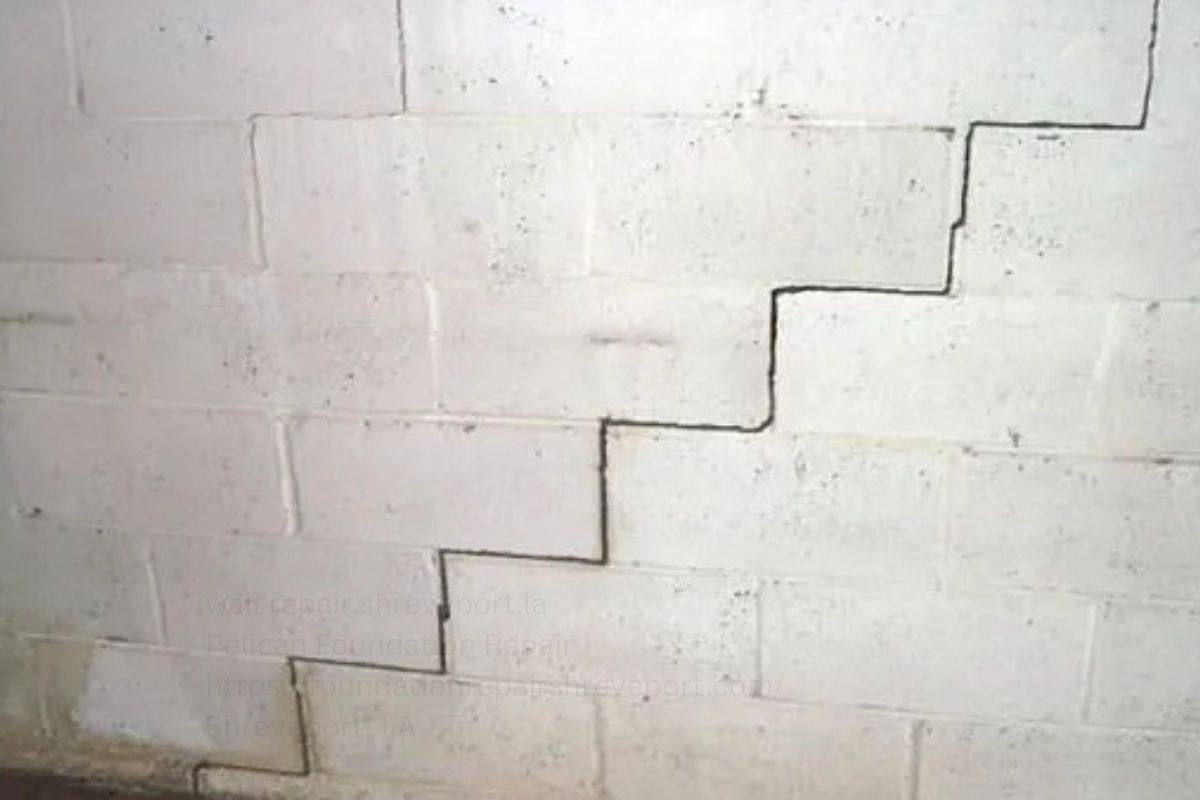
Brick and concrete block walls are strong in compression but the mortar joints are the weak links when the wall gets pulled or sheared. When one section of foundation settles lower than the section beside it, the wall cannot bend, so it breaks — and the break follows the mortar joints, jogging horizontally along a bed joint, then vertically up a head joint, repeating into the staircase you see.
The pattern is a diagnostic tool: the crack is widest where movement is greatest. Wider at the top usually means the section under the crack’s middle dropped; wider at the bottom suggests lateral pressure or heaving. Follow the descending “stairs” and you walk toward the settlement.
Length and location matter too. A stair-step crack running three or four courses in one garage corner is a different conversation than one climbing twelve feet up a two-story brick wall. And stair-stepping near a downspout discharge, under a large water oak, or beside a spot where a plumbing leak was fixed is practically the wall filing a report on what happened. For the other crack shapes you might see alongside these, our guides to vertical foundation crack repair and horizontal foundation crack repair complete the triage set.
Stair-Step vs. Other Cracks: Telling Them Apart
Not every zigzag is settlement, and not every straight crack is innocent. Here is how the common patterns compare:
| Crack Pattern | Usual Meaning | Urgency |
|---|---|---|
| Stair-step along mortar joints | Differential settlement — one section dropped relative to the next | Monitor; widening cracks need a pro |
| Straight vertical, hairline | Often shrinkage or minor settlement; common in new concrete | Usually low; seal and watch |
| Horizontal along a wall | Lateral soil or water pressure pushing the wall inward | Higher — get it evaluated |
| Diagonal from a corner of a window or door | Stress concentration; can be settlement or normal movement | Moderate; width and growth decide |
| Stair-step in brick veneer only | May be veneer movement independent of the foundation | Check whether the foundation behind it is cracked too |
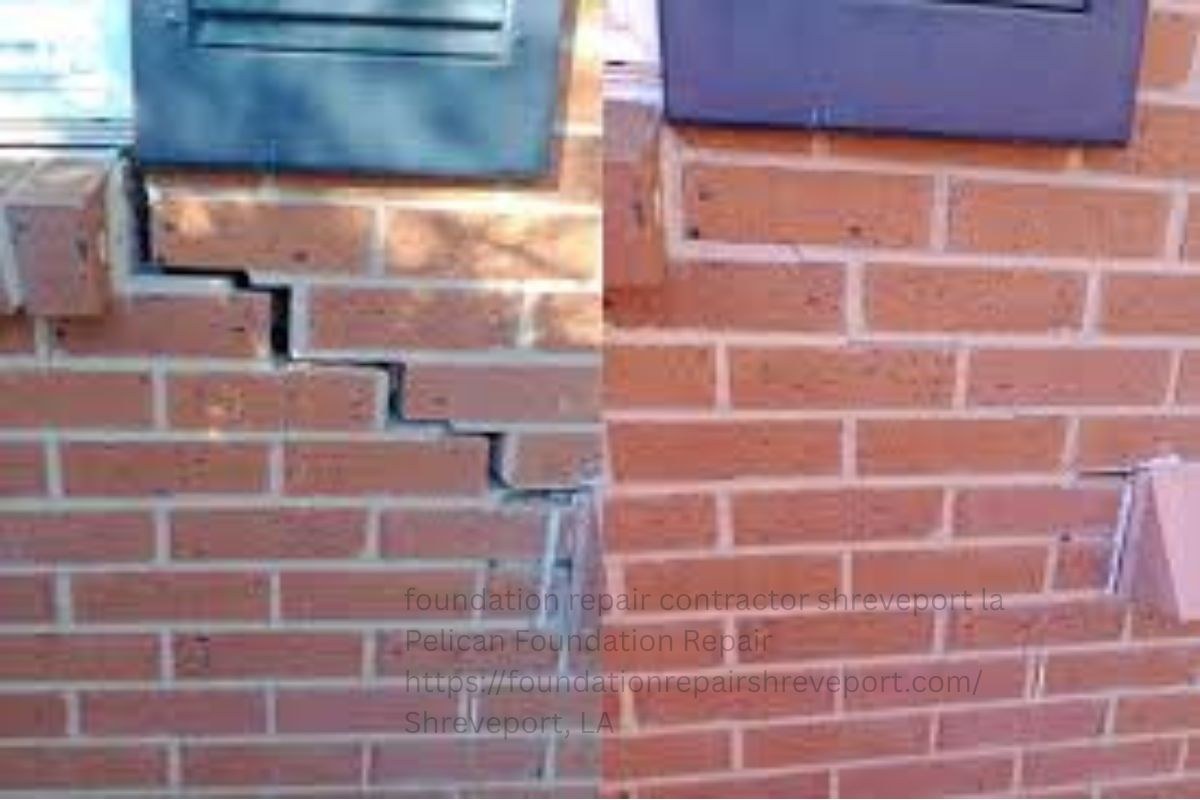
That last row deserves emphasis, because it trips up a lot of Shreveport homeowners. Much of the brick you see on local houses is veneer — a single layer tied to the wood-framed wall behind it, sitting on its own small brick ledge. Veneer can crack from its own settlement or thermal movement without the foundation moving at all. Before you panic, check the foundation wall or slab edge behind and below it. If the concrete underneath is uncracked and level, you may have a veneer issue — still worth fixing, but a different trade and price tag. If both show the pattern, the foundation is the story.
Width is the other great divider. Hairline stair-step cracks — under a sixteenth of an inch — are extremely common in our clay soil and often years old and finished moving. Once a stair-step crack approaches a quarter inch wide, or you can fit a pencil into it, it has crossed from “monitor” to “evaluate.” Our foundation crack repair services start with exactly this kind of pattern reading, so the repair matches the cause.
How to Tell If the Crack Is Still Moving
The most important question about any stair-step crack is not how it looks today — it is whether it is still changing. A crack that opened five years ago and has sat quiet since is a repair job. A crack widening this season is a structural problem in progress. Here is how to find out which one you have:
- Mark it and date it. Draw a pencil line across the crack at its widest point, write the date beside it, and take a close-up photo with a coin for scale. Repeat at two or three points along its length. This is your baseline.
- Re-check seasonally. Shreveport clay moves with the seasons — shrinking in dry late summer, swelling in wet spring — so a full year of checks catches the whole cycle. If the pencil marks have separated or the crack extended into new courses, it is active.
- Watch the companions. Cracks rarely move alone. Sticking doors or windows, new drywall cracks, gaps where wall meets ceiling, or a newly sloping floor all corroborate active settlement.
- Note the water. Did the crack widen after the rainy season? After a plumbing repair? Water events and movement events are linked in clay soil — the timing is evidence.
- Try the tape test. Stick clear packing tape firmly across the crack. If the crack moves, the tape tears or wrinkles. Crude but honest — and free.
A full year of monitoring sounds slow, and it is — deliberately. Foundation movement in expansive clay is seasonal and gradual. If the crack is already a quarter inch wide or growing visibly month to month, do not wait out the year; that is past monitoring and into evaluation. When movement is confirmed active, the fix has to address the soil support — which is where piers enter the picture.
Repair Options: From Stitching to Underpinning
The repair follows the diagnosis. A stable, non-moving stair-step crack and an actively settling one are different problems that happen to look similar:
- Stable hairline stair-step cracks: clean out loose mortar, repoint the joints, and seal. On block walls, epoxy injection can bond the crack. This is maintenance, not structural work — appropriate when monitoring shows no movement over a full seasonal cycle.
- Crack stitching: for cracks needing more than repointing where the foundation is not settling, carbon-fiber staples or stitching bars bridge the crack and distribute future stress.
- Active differential settlement: this is pier territory. Steel push piers or helical piers are driven past the unstable clay to load-bearing soil, then the settled section is lifted back toward level. Costs typically run $1,000 to $3,000 per pier, with a settling wall section needing several.
- Drainage correction alongside: whatever the structural fix, the water story gets fixed too. Piers without drainage work leave the original cause in place.
What you should not do: fill a widening stair-step crack with caulk or mortar and call it done. Sealing an actively moving crack is like painting over a check-engine light — it hides the symptom while settlement continues underneath, and the next bill is bigger. The LSU AgCenter documents how Louisiana’s expansive soils drive exactly this seasonal movement, which is why the monitoring step above matters so much here.
The Shreveport Differential-Settlement Playbook
Stair-step cracks do not appear at random; in northwest Louisiana they follow a familiar script. Learn the script and you can often spot the cause before the contractor arrives. The usual suspects, in rough order of frequency:
- Expansive clay doing its seasonal dance. Our clay shrinks in the long dry stretch of late summer — opening voids under footings — then swells when the wet pattern returns. Footings on sunny south and west sides dry faster than shaded north sides, so one corner drops while the rest holds: textbook differential settlement. Neighborhoods from Broadmoor to Keithville, ZIP codes 71105, 71106, 71115, and 71118, all sit on variations of this soil.
- Water concentrated in one spot. A downspout dumping at a foundation corner, a grading swale aimed at the house, or a daily-watered flower bed — any of these softens or erodes soil under one section. Floodplain areas and low ground near Cross Lake are especially vulnerable with an already-high water table.
- Plumbing leaks under or near the slab. A slow supply-line leak can wash out soil for months before the water bill or the crack announces it. In older neighborhoods — Highland, Cedar Grove, parts of Bossier — aging lines make this a regular find.
- Trees drinking unevenly. A mature water oak fifteen feet from the northeast corner pulls hundreds of gallons a day in summer, drying that soil while the rest stays moist. The dry corner settles; the stairs appear. Beautiful trees, real foundation consequences.
- Fill dirt settling. Newer subdivisions on graded fill see it compact over the first several years. If one side of the house sits on deeper fill — common on sloped lots — that side settles more, and the crack maps the fill boundary.
Notice what every item shares: uneven moisture. Differential settlement is almost always differential moisture first. That is why the professional inspection spends as much time on gutters, grading, and plumbing history as on the crack itself.
What a Professional Inspection Covers
When you call about a stair-step crack, a thorough inspection should include: mapping every visible crack with widths and locations, floor elevation readings quantifying how much each area has moved, checks of doors, windows, and drywall for corroborating signs, and a full exterior walk for the water story — grading, gutters, downspouts, plumbing history. You should receive a written report with the findings, the recommended repair, and a fixed price — not a verbal “looks like it needs piers” and a number on a napkin.
Bring your monitoring notes if you kept them — dated photos and pencil-mark observations are genuinely useful and show whether movement is seasonal or steady. Ask how many piers, where, and to what depth; ask what happens to drainage; ask for warranty terms in writing. We offer free inspections and a 20-year structural warranty on qualifying repairs, with every one of those inspection elements included. Start with Pelican Foundation Repair, Monday through Saturday, 8:00 AM to 6:00 PM, and you will know exactly what your crack is saying — and what it costs to answer.
Frequently Asked Questions
What do stair-step cracks in a brick wall mean?
One section of the foundation settled relative to its neighbor — differential settlement — and the crack followed the mortar joints, the weakest path. Small, stable ones are often just monitored; widening ones need evaluation.
Are stair-step cracks serious?
They can be. Hairline cracks under a sixteenth of an inch, unchanged for years, are usually low concern. Cracks near a quarter inch wide, growing longer, or paired with sticking doors and sloping floors signal active settlement.
How can I tell if a stair-step crack is still moving?
Mark it with a dated pencil line, photograph it with a coin for scale, and re-check seasonally for a full year. Separating marks or extension into new courses means it is active.
What is the difference between a stair-step crack in veneer and in the foundation?
Brick veneer can crack from its own movement without the foundation moving. Check the foundation behind it: uncracked, level concrete suggests a veneer-only issue; the pattern in both means the foundation is the cause.
Can stair-step cracks be repaired without piers?
Yes, when the crack is stable with no movement over a full seasonal cycle — repointing, epoxy injection, or crack stitching handles those. Active differential settlement needs piers driven to stable soil, because no surface repair holds a foundation that is still moving.
Why does the crack get wider at the top?
A crack wider at the top usually means the foundation beneath the crack’s middle has dropped, hinging the wall downward. The wide end marks the greatest movement.
Do stair-step cracks mean my house is unsafe?
Rarely in the short term. Most settlement cracking progresses slowly over seasons, not days. The risk is ongoing structural damage and water entry, not sudden collapse. Rapidly widening cracks or visibly leaning walls deserve prompt attention.
How much does it cost to fix stair-step cracks?
Repointing or stitching a stable crack typically runs $1,500 to $4,000. Active settlement needing pier underpinning usually costs $1,000 to $3,000 per pier, with full stabilization often landing between $8,000 and $15,000.
Pelican Foundation Repair
6118 Fairfield Ave, Shreveport, LA 71106, USA
318-585-2003
https://foundationrepairshreveport.com/